Thursday, May 31, 2012

DPW Spotlight Interview: Vinayak Deshmukh

Each week we will spotlight a different DPW artist who will give away one of their best paintings.

To enter to win Vinayak Deshmukh's painting, Repairs Before the Tide Comes In, go to DailyPaintworks.com and click on the Spotlight Giveaway button in the top-left corner of the website.


From Vinayak Deshmukh's DPW gallery page:


I am an artist from India. After graduating with a degree in engineering, I longed to return to my brushes. For the last seven years, I have been taking my art seriously. My work has been seen in state and national level juried exhibitions and today my paintings are in collections in India, USA, UK and Dubai.


Tell us a bit about how you first started painting.

I have been painting since I was a kid. I was fascinated by things such as railway locomotives, coaches, boats, etc. and would draw them endlessly from memory. That was when my parents felt that I had a genuine flair for drawing and encouraged me to pursue it as they thought it was time well spent.

In school, I would participate in various drawing and painting competitions and often win prizes. As I grew up, however, priorities changed and I had to concentrate on my studies and ensure that I got into a good professional course.

SPOTLIGHT GIVEAWAY: Repairs Before the Tide Comes In


(click here to see original image)

Enter to win by clicking the "Artist Spotlight and Giveaway" button!

In college I would often spend time in the Architecture library. This rekindled my interest in art and I started copying images from books there to learn the basic techniques of watercolor painting. After getting a degree in engineering and settling down in my job, I still felt the same inclination towards art. In the last seven years or so, I have been painting seriously and hopefully making progress...

Did you have any stops and starts in your painting career?

Painting for me was only a pastime up until a few years ago. In school it was mostly an activity to be cultivated in the summer vacations.

The longest break I had was for about 5 or 6 years, when I was in high school and then in junior college. After engineering college, I could not paint for a couple of years again, as the priority then was to stop changing jobs and settle down in one I liked. For the past six years or so, I have been painting more or less regularly.

What mediums and genres have you experimented with? Which ones have "stuck" and which ones have fallen away? Which ones are you looking forward to exploring?

I have been using pencil and watercolour most of my life. In the last few years I have tried to explore oils and charcoal too. Each of them has unique characteristics that appeal to me. I love the fluidity and transparency of watercolour and also the impasto nature of oils. I haven’t tried many other mediums. I love works done in pastel and hope to add them to my repertoire someday.

As far as genres are concerned, I like all the three major ones in realistic painting – portraiture, landscape and still life. I haven’t done much of animal portraits though and would love to try my hand at that.

As If Nothing Has Ever Happened
(click here to see original image)

There's such a wonderful quality of delicacy and light in your work. Can you describe your process for making sure the whites are "just bright enough" to look right?

Thank you for the compliment. Yes, light and its effects are definitely the most important things I try to capture in my paintings. The light temperature, intensity and contrast are crucial in creating the mood.

I make many value sketches before I start a painting - sometimes as many as 10 or 12. They help me finalise my value scheme and decide upon my lightest lights and darkest darks. By placing suitable values around a certain shape, I can ensure that it appears just as bright or as dark as I want it to. All these things can be worked out much easier in a value sketch. They are even more useful with watercolours because of the limited extent to which watercolours can be corrected.

Adasa Rooftops
(click here to see original image)

What does procrastination look like for you? What techniques work to ensure that you make time for your art and actually start painting?

Procrastination is a scary guest and doesn’t go away soon once it comes to stay. So I need to be really vigilant against getting lazy.

I have a day job and am often quite tired in the evening to take up any serious creative work. I therefore paint routinely in the mornings. I ensure that I do at least 3 hours of serious painting every morning before I start for work.

On Sundays and holidays, I start painting even before sunrise so I can paint for as much as 6 hours without compromising on family time. It’s not necessary that I come up with a finished painting every day, but I ensure that I follow this routine at least 4 days a week. Sometimes, depending on my energy levels, I do value sketches and other preparation for a painting in the evening. This way I ensure that I can directly start the final painting the following morning.

How do you generally arrive at ideas for your paintings?

I am always on the lookout for new ideas and subjects to paint. Some of the most beautiful subjects present themselves in the most unexpected of places. I work both en-plein air and indoors.

When working indoors, I use photographs and outdoor sketches for reference. If I do not like a scene as it is, I edit out certain things and add others from my memory and imagination, but ensure that I retain the essential character of the scene.

I often make field sketches hoping to convert them into serious paintings someday. Alongside these sketches, I also take down notes regarding the direction of light, the general atmosphere and anything else that I found unique about the place. This information comes in handy to recreate the mood, especially when there is a long gap between doing the sketch and the final painting.

Anxious
(click here to see original image)

How do you keep art "fresh"? What techniques have helped you avoid burnout and keep your work vibrant and engaging?

It is very important for me that I understand my subject thoroughly and know exactly why it appeals to me. I then try to communicate the same with my brushes.

I find inspiration in the works of other, more accomplished artists. I feel trying out different mediums and genre once in a while helps to avoid stagnation. I love to travel and take lots of photos for future reference. A change in subject matter gives me new ideas and suggests the need to explore newer techniques of handling paint.

I make sure that I take up all serious painting only when I am fresh, energetic and in a peaceful mental state. I believe that a dull and bored mind will result in dull art. A bit of yoga and meditation before painting is really helpful.

There are occasions when I do not feel very enthusiastic and excited about putting paint on paper. At such times I do other not-so-interesting activities, which reminds me of the pleasures of painting that I am missing. This makes it easier to get back to the easel.

Plate with Fruits
(click here to see original image)
What do you feel you are learning about right now as an artist?

I guess right now I am learning a lot about the use of colour. Mixing the right colours is very effective in communicating a certain mood or feeling. One other thing I am definitely learning is edge control and the wonderful effects one can achieve with a judicious choice of edges.

What makes you happiest about your art?

The fact that I an enjoying every moment of it!

Thanks, Vinayak!


© 2012 Jennifer Newcomb Marine

Jennifer Newcomb Marine is the Marketing and Community Manager of Daily Paintworks. She's an author and blogging and marketing coach.


Friday, May 18, 2012

DPW Spotlight Interview: Clair Hartmann

Each week we will spotlight a different DPW artist who will give away one of their best paintings.

This week we are spotlighting Clair Hartmann, who is giving away her beautiful painting Summer Marsh, which you can see below.

To enter to win this painting, go to DailyPaintworks.com and click on the Spotlight Giveaway button in the top-left corner of the website.

From Clair Hartmann's DPW gallery page:
Clair Hartmann began daily painting in 2007. Her work can be found in private collections, institutions and numerous galleries around the globe. Her Downtown Dog Project (100 dogs in 100 days) is now available in book format.

Tell us a bit about how you first started painting.

When I went to the Art Institute of Ft. Lauderdale to study graphic design, they offered painting as part of the required curriculum, so I started there. I remember sitting in the hallway in my dorm room first trying oil paints, looking at the muddy brown and gray mess, thinking, "How does anyone paint with this stuff?" Eventually, I figured it out.

Mutt

(click here to see larger image)

My first real painting was of my son, which I completed in one night for a grade in the morning. I got an A and it was on display at the school for a few weeks. I'm not sure how I got from a muddy mess to a legible painting, but I did somehow!

Did you have any stops and starts in your painting career? 

Yes, my painting has been sporadic up until four years ago, when I seriously decided I wanted to stop my graphic design company and paint for a living. The longest stop ever was for about 8 years, when I quit drinking 16 years ago. Drinking became so much a part of my painting, it seemed impossible to separate the two, but painting pulled me back in.

When I was ready to get serious, I started doing a painting a day and although completing a painting a day was sometimes not possible, it was my goal. About a year into doing a painting a day, I didn't feel as if I was truly enjoying it. I knew it was what I needed to do with my life (my path, calling, etc.) but for some reason, I wasn't enjoying the process.

Eventually, I became somewhat fearless... not so focused on mixing colors, thickness of the paint, linseed or thinner, etc. and most of all, not afraid to make mistakes. It wasn't until then that I could fully enjoy just sitting and painting. Now it's evolving into a meditative process for me.

Fritz (commission)

(click here to see original image)
I guess it's like learning to walk, in the beginning you are so focused on the mechanics, you can't fully enjoy a stroll. Then when it becomes second nature, you don't even have to think about it. Then not only can you walk and enjoy, you even can skip.

What mediums and genres have you experimented with? Which ones have "stuck" and which ones have fallen away? Which ones are you looking forward to exploring?

I really love oil paint with a mix of 1/2 and 1/2 odorless thinner and linseed. I'm starting to use Gamblin Radiants and just love them. I have found that Williamsburg burnt sienna is opaque and Windsor and Newton is transparent, which is good to know because I use a lot of it painting dogs.

I don't use black anymore, using a mix of ultra marine and burnt umber instead (or orange or raw sienna for variations) to create a rich black in which you can lean to a warm black or cool black easily by adding more or less of either color. For larger brushes, Princeton are the best and worth every penny. For smaller, Rosemary and Co. last the longest.

As far as subject or genre, I like painting other subjects to stay fresh, but I always come back to the dogs and I have been really enjoying imaginary realism lately. I have had people say to me "Don't get pigeonholed into painting dogs," and I find it funny that no one ever says "Don't get pigeonholed into painting figures or still life..." I love painting dogs and I love my paintings of dogs and if that's what I get known for, it's fine with me.


King Martin

(click here to see original image)

I have no idea how you do this, but your dog paintings in particular do such an amazing job of capturing each animal's essence that I actually feel as if I could reach out and pet the dog! Thoughts?

I think as a painter, when you feel passionate about a subject, you tend to want to communicate it in your paintings. Dogs add so much to our lives and when I see an essence that pulls me in, I want to recreate it in my painting.

Eyes are so important in painting dogs. Eye contact is how we communicate with them. They watch everything we do, anticipating every move we make. We know when we look into their eyes, they love us and it makes us love them, it connects us.


Big City Dog

(click here to see original image)

What does procrastination look like for you? What techniques work to ensure that you make time for your art? 

When I start randomly cleaning the house, I know I'm avoiding a painting.

So I start cleaning the studio and organize to stay in the zone and not avoid. I lay out a canvas ready to paint and my paints and brushes and when I get up early in the morning, the first thing I do is start painting. It helps to have music in earphones to get in a meditative state.

How do you generally arrive at ideas for your paintings? 

Just thinking, a lot of it. Sometimes preparation for a painting takes longer than the actual painting. I always have ideas going on in my head of what I want to do. I love metaphors and try to illustrate around a metaphor that tends to stay awhile in my brain. I use photoshop and move around photos with other photos to get an idea of how it'll look.

How do you keep art "fresh"? What techniques have helped you avoid burnout and keep your work vibrant and engaging. 

I try not to paint just dogs and go from a lot of other subjects. When I feel like taking a break, I do and try not to feel guilty, when I'm ready, I'll start to miss it and be painting again.

SPOTLIGHT GIVEAWAY: Summer Marsh 

(click here to see a larger image)


Enter to win by clicking the "Artist Spotlight and Giveaway" button!                  


What do you feel you are learning about right now as an artist? 

Color and brush technique. Last year I took a class from Susan Hecht and she introduced me to correct color and pushing color. It blew my mind and was very confusing at the time, but now I think I'm getting the hang of it and really enjoying the challenge.

As far as brush technique, I'm trying not to be so controlling and letting the stroke have a personality. Trying to keep a realistic style, balancing it with a painterly stroke and allowing mistakes. At a recent lecture I attended, Charles Movalli said "Mistakes are our signature..." Love that!

What makes you happiest about your art? 

That I'm doing it sober and really enjoying it.

Thanks, Clair!


© 2012 Jennifer Newcomb Marine

Jennifer Newcomb Marine is the Marketing and Community Manager of Daily Paintworks. She's an author and blogging and marketing coach.


Friday, May 11, 2012

DPW Interviews: Mary Maxam


From Mary Maxam's DPW gallery page:
A native of Idaho, Mary Maxam finds inspiration for her paintings in the beautiful scenery and gardens of the Northwest. She is a graduate of Boise State University and has studied in many professional workshops, teaching art for many years herself. Mary's work has shown in many juried national exhibitions and has contributed both painting and written work for book and magazine articles on painting and design.
Tell us a bit about how you first started painting.

I've been drawing and painting all my life it seems. I started to focus more on wanting to be an artist and/or teach art while in high school. I always liked crafts too, along with all the materials and processes involved with the visual arts.

Iris Garden
(click here to see original image for sale)

Did you have any stops and starts in your painting career?

When I first began teaching high school art, time was so hard to find. I knew it would be important to try to continue my own work along with teaching. That turned out to be harder than I thought. I sometimes just didn't have the energy for real development of work at the end of a teaching day.

However, I did over time, get into a pattern of evening painting, and tried to get in an hour or two of either painting or drawing on most days. Doing so helped me to continue to be an artist in my own right.

What mediums and genres have you experimented with? Which ones have "stuck" and which ones have fallen away? Which ones are you looking forward to exploring?

I painted in watercolor for many years and loved the variety of ways watercolor can 'look.' It was also a pragmatic decision, because I just didn't have a realistic space for oil painting. About 10 years ago, the galleries I were with began asking more and more for oil, which I'd wanted to explore myself. So, I took it as a sign to make a change and primarily work in oil.

I also have a larger and better space now for working. While teaching, I both experimented with and taught using a variety of mediums, but for for my own work watercolor and oil 'stuck'.

His Best Side
(click here to see original image)

One of the first words that comes to mind for your art is lush. What have you learned over the years about accurately reflecting the intense colors you're seeing in your subject matter on the canvas? 

I love that compliment because I do frequently have that reaction to the subjects I'm attracted to. I want to paint their lushness somehow. I think one thing I keep relearning is that sometimes less is more. If all the colors on the wheel are on the painting, they all compete for attention. If I make one or two colors the stars of the show, so to speak, then I can use compliments or analogous colors to help them 'say more.'

I've been recently trying to use more colorful grays to contrast with pure tones, I enjoy that a lot. Also, transparent color next to opaque color is something I love to contrast and it's effective for me.

Fabulosity and Her Court
(click here to see original image for sale)

What does procrastination look like for you? What techniques work to ensure that you make time for your art?

I rarely have a time when I don't want to paint, so I guess I'm lucky that way. I tend to have the opposite problem, jumping into a painting before I've considered my aim long enough.

When the issue comes up, I usually just go make panels or clean brushes - just getting into the studio or where the paints are helps. One things leads to another and I find myself with a brush in hand. I procrastinate more in getting the laundry or dusting or organizing done - ha!

How do you generally arrive at ideas for your paintings?

I use photos, sketches and plein air work to develop paintings. It's not as much the subject for me, as the way light or color catches a particular subject. My eye locks onto something and then I try to visualize an idea for a painting from that. I am usually able to find that spark with flowers, landscape or fly fishing figures on a stream, subjects in a natural setting.

Drift
(click here to see original image for sale)

How do you keep art "fresh?" What techniques have helped you avoid burnout and keep your work vibrant and engaging?

I like to rotate several subjects, as my blog followers can attest to! When my work isn't engaging to me, I try asking myself, What do you want to see? (as opposed to what's in front of me).

When I work on a painting that has been freshly toned and the surface is still wet, the opaque color stroke that goes over the top of it, continues to be an interesting surprise. It's a stepping off point and not something that you can completely plan or explain.

What do you feel you are learning about right now as an artist?

I really need to pre-plan compositions more thoroughly instead of diving in too quickly. Especially, with larger works, which I have been trying to find time for! I'm still on that path to finding my own voice and hope to continue and refine that search.

Window Box Floral
(click here to see original image for sale)

What makes you happiest about your art?

There are those times when a painting just flows from brain to brush and there is no 'second guessing' -  it just feels like Aaahhhhhhh... so great! And when I have a painting that 'clicks' with people so that they feel I've caught something personal for them!

I like the constant striving and problem solving too - there's always another painting around the corner....

Thanks, Mary!


© 2012 Jennifer Newcomb Marine

Jennifer Newcomb Marine is the Marketing and Community Manager of Daily Paintworks. She's an author and blogging and marketing coach.


Friday, May 4, 2012

DPW Interviews: Mineke Reinders


From Mineke Reinders DPW gallery page:
Mineke Reinders was born and raised in the Netherlands, studied art at Texas A&M, has lived in Turkey and Germany, and resides in the U.S. She has painted in watercolor - sometimes combined with gouache - for the last 20 years. Mineke has exhibited in Europe, the US, and Turkey. Her works are in public and private collections in many countries.
Tell us a bit about how you first started painting.

I have drawn and painted for as long as I can remember, but was encouraged to choose a 'sensible' career path - in other words, not art. I liked to read too, so I became a librarian. I had a succession of jobs that weren't bad, but did nothing to satisfy my creative urges.

Shopping
(click here to see original image)

In my free time, I knitted, sewed, grew plants on a balcony, and painted. I remember some pretty horrible oil paintings I did at that time. All Angst and no skill.

I gave that up for a while, until one day, I saw an ordinary scene in my town in Holland suddenly differently, as if transformed into something more intense, more vivid, almost magical. I did two collages based on that experience, having chucked my paints a few years before.

Not long after that, I had the good fortune to spend a semester in Florence, Italy. The experience of living abroad for the first time, and the overwhelming visual impact of Florence and its surroundings, made for many more such moments of intensified seeing and feeling. This is not something I can describe in words, it needs a paintbrush, and that is how I came to be a painter.

Did you have any stops and starts in your painting career?

No real stops, but I slowed the pace at various times, for example, after we bought our first house in Texas, and our current house in Illinois, which both needed some TLC, and during the years when my daughter was little.

What mediums and genres have you experimented with? Which ones have "stuck" and which ones have fallen away? Which ones are you looking forward to exploring?

I've tried a lot of mediums (oils, acrylics, pastels, watercolor, gouache, egg tempera, casein, monotype) but I always come back to watercolor and gouache. I love oils too, and hope to use them again at some point.

In terms of genre, I've always gravitated towards landscape, from the endless flat vistas of south Texas, where I was an art student, to the cities of Europe and Turkey. I don't think my genre will change much, as it continues to fascinate me, but I'm open to possibilities.


You are my songs
(click here to see original image)

Many of your pictures really capture a mood, as if there could really be a story there, especially in certain settings that some might consider quite "plain." Your thoughts on this?

Thank you. Mood, or the spirit of place, is the driving force behind most of my work, and I find it most often in humble settings, in overlooked places, in decay even. I feel that in those places, the past is alive alongside the present. At least, that is what I try to capture and convey.

The old city of Ankara, Turkey, which has inspired a lot of my work in recent years, is rapidly being modernized. When I lived there, in 2006, I sensed that there was an opportunity to capture something beautiful that would not survive much longer. That turned out to be true, as some of the places I painted are no longer there or have been modernized beyond recognition. I have exhibited those works in Ankara a few times, and it's been very gratifying to see how people there responded to them with great affection.

There are more days to see
(click here to see original image)

What does procrastination look like for you? What techniques work to ensure that you make time for your art?

When my daughter (now 13) procrastinates about her homework, it's because homework is boring. There are so many more interesting things to do! I am never bored with painting, so when I procrastinate, it's a matter of fear or frustration. After a few failed paintings, I can find distractions to avoid facing the blank sheet of paper.

I wouldn't recommend procrastination as a habit, but I think occasionally it's not so bad. It gives the brain a chance to process problems and come up with new ideas. Sometimes even in dreams or while waking up, suddenly there is the answer you couldn't find before.

How do you generally arrive at ideas for your paintings?

My ideas come from a lot of sources: memories, photos, sketches, music, imagination, studying the works of masters. I don't paint on location very much, because the places I like to paint are not near where I live. I use photos and sketches to take me back to the places I want to paint. I realize the limitations of this, but I want to paint the things that speak to me, even if they are far away. This does not mean copying photos, but instead using them to trigger memories and imagination.


Accidental beauty
(click here to see original image)

I also sometimes use photos taken by a dear friend in Turkey (with his permission, of course) of places I have not even visited in person, because they are as meaningful and familiar to me as if I had been there myself. I think this is going against the Zeitgeist a little, but I do believe there is a place for the imagination in art, in addition to direct observation of reality.

How do you keep art "fresh"? What techniques have helped you avoid burnout and keep your work vibrant and engaging?

I love to travel, discover new places and revisit old ones. That is a major source of renewal for me.

Besides that, I like to visit art museums and galleries, not just for inspiration, but to expose myself to different ways of making art. I look at a lot of art online, and really enjoy it and learn from it a lot, but there is a special charge you get from seeing great art up close and personal.

What do you feel you are learning about right now as an artist?

I am focused on composition and values right now. I've read a lot of books and articles about composition, but feel that they are generally too formulaic. I want to learn how to make my paintings more cohesive, without relying on simplified systems.

I also want to study the use of values, because I feel that it's essential - in representational painting - to conveying a sense of space. To look at a painting and feel that you could walk into it and be there is a kind of magic I would like to master. I feel that that can only be accomplished by knowing, understanding and applying values and perspective correctly.

It has taken me 20 years to even arrive at this realization, but perhaps I'm a slow learner.

Evening Light
(click here to see original image)

What makes you happiest about your art?

Difficult question! The feeling that a painting is going to work is exhilerating, looking at a painting that came out better than I thought is great too. Knowing that people relate to my paintings makes me feel happy and grateful.

But perhaps the best thing of all is knowing that the journey never ends. The more you learn, the more you know that you don't know, and that leaves the road open endlessly.

Thanks, Mineke!


© 2012 Jennifer Newcomb Marine

Jennifer Newcomb Marine is the Marketing and Community Manager of Daily Paintworks. She's an author and blogging and marketing coach.

Thursday, April 26, 2012

DPW Interviews: Nora MacPhail


From Nora MacPhail's DPW gallery page:
Nora MacPhail is a professional watercolour artist living in Toronto, Canada. She has participated in numerous group art shows as well as juried shows. She is a member of the Toronto Watercolour Society, The Willowdale Group of Artists, Forest Hill Art Club and Central Connection. 
Tell us a bit about how you first started painting.

I began watercolour painting over a decade ago and I took to it immediately. I never found it frustrating, like so many students do.

However, I did abandon watercolour for a few years because I thought 'serious' painters were 'supposed' to use oil. Fortunately, I found my way back to it.

Zebaydo takes the lead
(click here to see original image)

Did you have any stops and starts in your painting career?

I almost stopped painting very early on because of a horrible art teacher I had. But I liked watercolour and I had excitedly purchased every single brush, paint colour, type of paper and many other supplies, so I figured I'd better give it another go!

What mediums and genres have you experimented with? Which ones have "stuck" and which ones have fallen away? Which ones are you looking forward to exploring?

I have experimented with oil, acrylic, gouache and watercolour. Then I took a watercolour workshop with Alvaro Castagnet who told us that "Watercolour is not what you think it is; we've barely scratched the surface of it's possibilities."

His words of wisdom just struck me. Watercolour has a long way to go and I want to be part of that progress.

hey neighbor
(click here to see original image)

There's such a wonderful blend of confidence and humor in your art. How did you arrive at your "less is more" approach, where you sometimes combine just hints of shapes and color with a strong theme?

I don't know that there is 'humour' in my art. I am going for a sense of playfulness combined with solid technique. It's important to me that the paintings are well crafted and skillfully painted, but with a dash of playfulness. If you have one without the other you end up with all technique, like photorealism, which I'm not fond of, or just a playful artsy-fartsy mess, which I'm also not fond of. I'm a firm believer in balancing both.

What does procrastination look like for you? What techniques work to ensure that you make time for your art?

I don't have a problem with procrastination, in fact I want to paint so many things that having too many ideas actually distracts me. I have many projects swirling around in my imagination. I have to concentrate and focus on one idea.

I say to myself, this is what I am painting right now, today. Other ideas have to wait until tomorrow.

window light
(click here to see original image)


How do you generally arrive at ideas for your paintings?

I paint whatever I want. I paint what is in front of me and inspires me. I'm not looking for a niche or concerned with what sells. If I don't paint what I want, it all falls apart.

How do you keep art "fresh"? What techniques have helped you avoid burnout and keep your work vibrant and engaging?

I draw the human figure as often as possible to develop my drawing skills. Life models are such a great way to learn to draw. All the difficulties of shapes, form and light are right there to work with and learn from.

What do you feel you are learning about right now as an artist?

I'm learning how to incorporate line into my watercolours. I want my line, including construction lines, to be an integral part of the painting.

red stripes
(click here to see original image)

What makes you happiest about your art?

My favourite thing to do is to draw. It's such a wonderful thing to have in one's life. It's a highly satisfying activity. Of all artistic mediums, drawing is the best way for me to find my style. It just develops naturally, like a signature. There's no point in attempting to draw like someone else, it's a personal activity.

Pencil and paper is cheap, it's fun, it's light to carry, it's immediate, and it's highly challenging.


© 2012 Jennifer Newcomb Marine

Jennifer Newcomb Marine is the Marketing and Community Manager of Daily Paintworks. She's an author and blogging and marketing coach.

Friday, April 20, 2012

DPW Interviews: Elena Katsyura


From Elena Katsyura's DPW Gallery page:
She was born in Russia and received her Master's degree in Art in her native city of Chelyabinsk. Her artistic creed is a combination of the traditions of Russian realistic art and French impressionism. Her paintings have been shown at exhibitions in Russia and in California and she currently resides in Georgia, U.S.A., with her husband and daughter.
Tell us a bit about how you first started painting.

In my childhood, I was very interested in everything that had to do with art. I had many collections of postcards with drawings that I found pretty or unique, and I still keep those postcards. I was always into art books and could look at one painting for hours. Later, in elementary school, I enrolled into the Children’s Art Studio in Chelyabinsk, Russia. I loved the place, I loved to draw and paint. I felt that I truly belonged with art.

That was my true start in painting that kept me going my whole life.

Peach and Black Grapes
(click here to see original image)

In my middle school years, I attended a more serious art school for children my age. I learned to paint better there, and decided I would move onto Art College. There, I fell in love with both watercolor and oil painting, but later picked just oil and I have been painting with it ever since.

Did you have any stops and starts in your painting career?

Well,  when I gave birth to my daughter in 1999, I had a minor pause in my artwork, but resumed shortly after my daughter began growing up. I find that I cannot live too long without my paintbrush, and that it is hard to take a long break from my artwork. Since my daughter is 13 now, I am painting regularly and find no need to stop my art.

What mediums and genres have you experimented with? Which ones have "stuck" and which ones have fallen away? Which ones are you looking forward to exploring?

I am not really an experimenting person. I tried some acrylic, some watercolor, but I stick with oil. I find it the best medium for me, and currently in Daily Paintworks, I paint only in oil.

Maybe when some time has passed and I become even more experienced with my art, I will take a break from oil and pick up watercolor once more.

Black Coffee
(click here to see original image)

You capture such fine details in so many of your paintings. Have you gotten "faster" at painting accurately over the years?

I find that now that I am painting at least one painting every day, I am getting better, and know what techniques to use and when. I try to remember my previous painting each day and keep mental notes about certain colors to use this time, what brush to use for specific details, and so on.

I remember that one day I thought about what certain type of color to use on a detail in my painting. Then I referred to one of my other paintings, and found out which color I had to use. Referring to my previous paintings helps me a lot in my new paintings, because I learn from my mistakes.

What does procrastination look like for you? What techniques work to ensure that you make time for your art?

I don’t remember a time when I had a problem with procrastination. But then again, I have never painted daily, and always tried to schedule when I would work on a painting.

A couple of years ago, I worked on maybe two paintings a month, because my daughter was still pretty young and dependent on me. Whenever I would try to get some painting done, she would interrupt me and I was once again back where I started on my work. Nowhere.

Now that my daughter is pretty much grown-up and can find activities to do without my help, I paint daily. It also helps that she is in school from 8:30 until 3:30, so I have plenty of time to paint.

If I don’t have anything scheduled for the evening, I work on another small painting as well. I am usually not in a hurry to get my painting done, and I have a peaceful environment behind my easel.


Paris Memories III


How do you generally arrive at ideas for your paintings?

I get ideas mostly from nature. Whenever I see a flower or a pretty leaf growing somewhere in the middle of the highway, I am frustrated that I don’t have the chance to pick it. When it was autumn, I had a large variety of red and golden leaves that I would paint with my teacups. Now, in spring, it is blooming time, and many of those blooming blossoms and flowers have ended up on the table in front of my easel.

I am also thrilled with the idea that I have a “real live” magnolia tree right in my own backyard! My neighbor’s magnolia is already blooming, so I am expecting my own tree to start producing those gorgeous white flowers sometime soon.

Although it sounds like I am having an easy time just simply picking flowers and setting them in front of my canvas, whenever there isn’t an item from nature nearby, I have a very hard time deciding what to paint. I am famous for my teacups, but I notice that so many of my paintings have teacups on them.

My husband is a great help in giving me advice on what to paint, and I am always grateful for a few pointers. Actually, I forgot to mention that my husband graduated from the same Art College as I did, and it is where we first met. So, naturally, my husband is a good drawer himself, but since he is a teacher and linguist, he doesn’t have time for any serious painting.

How do you keep art "fresh"? What techniques have helped you avoid burnout and keep your work vibrant and engaging?

Now that I am painting for DPW, I paint every day and usually on 6”x6” gessoboards.

What is very new for me is this tiny painting size. I feel that that is very fresh, and it is amazing how I can fit so much information that the still life in front of me carries on a 6”x6” limited format.

My teacups surrounded with flowers, leaves, and fruit; the vases of flowers; and especially Two Kids from my new “Farm” series simply fascinate me with their ability to fit onto the tiny canvas. But those small paintings carry meaning, and the miniatures that capture interest are the best ones of all.


A Day on a Farm


What do you feel you are learning about right now as an artist?

Ever since I signed up for DPW, I found out that it is actually possible to paint daily, monthly, yearly. I am continually painting and finding out more from others.

Before I came to the USA, I didn’t have a blog, and didn’t have any experience in describing my paintings, so this is something else new. Since my first language is Russian, and my daughter is way ahead of me in learning English, she often helps me translate my ideas from Russian into English, even though she is currently 13. Now I am learning to write descriptions for my paintings in both my blog and DPW.

Pansies and Autumn Leaves
(click here to see original image)

What makes you happiest about your art?

I just love returning to my easel every day and accomplishing something I had in mind, as any other artist would! I try my best, and once in a while I have a bad day, but it always turns out fine the next time I paint. I thank God that He has given me an opportunity to express myself through the wonderful study of art.

Thanks, Elena!


© 2012 Jennifer Newcomb Marine

Jennifer Newcomb Marine is the Marketing and Community Manager of Daily Paintworks. She's an author and blogging and marketing coach.

Thursday, April 12, 2012

DPW Interviews: Brian Buckrell

From Brian Buckrell's DPW Gallery Page:
Brian retired from the University of Guelph (Veterinary Medicine) in Ontario, Canada in and relocated with his wife to British Colombia. He has won numerous competitions and awards for both his studio and plein air paintings and is represented by galleries on Vancouver Island, in Alberta and Ontario. 
Tell us a bit about how you first started painting.

I retired to Vancouver Island in 2001. In 2003, my wife signed me up for a Painting on the Right Side of the Brain course -- for my 60th birthday. I was fascinated by it, so I took a local acrylic painting course and was hooked.  I painted for a year and read as much as I could, then decided I needed more basic knowledge.

Around the Meadows
(click here to see original image)

I took Barry Raybould's Virtual Art Academy course and found it brought structure to the learning of what to me (with a background in science) seemed to be a very unstructured  and confusing discipline to grasp. That made me want more, so I went on-line and organized a series of artists that I wanted to spend time with and spent the next few years travelling in Canada and the U.S., taking workshops. 

Finally, I decided that I needed serious instruction and continuity in my learning, so I spent six months at the Jeffrey Watts Atelier in Encinitas where I painted and drew from life: portrait, figure, still life and plein air. They completely broke me down, then started to rebuild me. 

Since then, I've averaged two workshops per year and continue to develop on my own. 

Did you have any stops and starts in your painting career?

No real stops and starts, but I developed prostate cancer prior to attending Watts. That set me back in some respects, but also made me more intent on learning what I could while I could -- not knowing the outcome. 

It was then that I decided that this was what I was going to do.

Island Evening
(click here to see original image)
What mediums and genres have you experimented with? Which ones have "stuck" and which ones have fallen away? Which ones are you looking forward to exploring?

I started with acrylics and it is my main medium today. I like the immediacy of response to changes. I am a "what if" painter and am constantly making changes and changing again. With acrylics, I get that instant feedback. As a result, they have given me the confidence to take risks and explore new approaches in my work. I particularly like using them for large pieces where I wield big brushes and get quite animated. 

But I also enjoy oils (I work in water soluble), particularly the small pieces -- both studio and plein air. I spent the last six months working mainly in oils to try to loosen up my approach with them and take the artistic risks I am comfortable taking using acrylics. That was my interest in taking Carol Marine's workshop last month and my reason for joining Daily Paintworks -- to see if I could find interest in these small experimental pieces. 

Joining DPW created issues with some of my galleries, but we worked out an understanding that I would only display the small pieces -- for which there is little or no return after framing and gallery commissions.

Even in your darker, moodier work, the quality of light is wonderful. Can you describe your approach to capturing accurate brights and darks?

Wow, heavy question!  

I have been taught to consider values first and foremost to make a painting interesting and attractive. I spend time planning each piece -- studio or plein air -- doing small value sketches and trying to create interesting patterns.

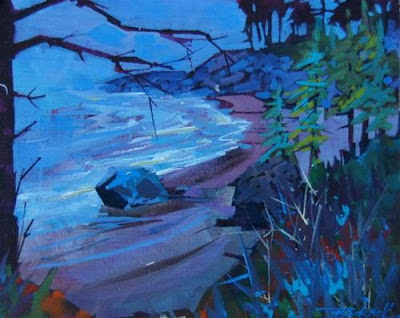
Oregon Coastline
(click here to see original image)

For my acrylics, I normally create a value under-painting. After placing the drawing, I apply a dark transparent acrylic with medium/water and use rubber shapers to remove according to value, leaving a three value pattern. Doing so gives me a chance to consider my large shapes in advance and make early changes. 

I also do a lot of down-glazing with dark transparents as the painting progresses, to even out values and create a bit of a mother colour, then bring back the lights with opaques.  Examples of this approach can be seen on my blog.

What does procrastination look like for you? What techniques work to ensure that you make time for your art?

I don't have a problem with procrastination. I love the challenge of making paintings. My goal this year is to paint less, to try to bring more balance to my life.  

My day starts early and I have found that once I start painting, I am lost. So I have started my day by doing little things I need to do for a hour or so (DPW, blogs, emails, Facebook, etc.) before I get into the painting. Then I force myself to stop about noon, go for a workout or bike ride, then do other things (many art- related) for the rest of the day. 

So I'm trying to hold my painting to about 5-6 hrs per day of actual brush-in-hand time, 5-6 days per week. 

How do you generally arrive at ideas for your paintings?

I live in (and next to) a beautiful and interesting country. We travel in our RV for 3 or 4 months each year from which I gather reference photos and do plein air sketches.  I am constantly seeing sites that excite me and cause me to  wonder, "Could I or how would I paint that?" Even faces excite my interest. 

Tibetan
(click here to see original image)
Generally, it is the challenge of trying to make something interesting out of something that is often very ordinary... 

How do you keep art "fresh?" What techniques have helped you avoid burnout and keep your work vibrant and engaging?

There is still so much to learn that I don't feel the pressure of burnout. I also have a wife that gives me her full support and encouragement  -- and that is essential as I am not pressured to do other things. 

Being in my late sixties probably makes my perspective different than someone younger or who must paint for a living. I so appreciate having found this passion at this stage of life that every day is an adventure.  I also have had the good fortune to be able to sell my work from early on and that keeps me moving forward -- believing that each painting should be better than the last.

I continue to take workshops. I love being with artists more experienced and skilled than I. Most workshops bring that. 

The other thing that has been wonderful is teaching. I do a five-day Fundamentals for Landscape Painters and a two-day Preparing for Plein Air workshop. Teaching forces me to keep current and makes it necessary to constantly review. The best way to learn something is to teach it. 

What do you feel you are learning about right now as an artist?

The past six months have been quite interesting. I made the plunge into on-line marketing and exposure to see what would happen: web sales, DPW, Facebook, blog, etc. 

It has taken me from my little town on Vancouver Island to interacting with artists and buyers all over the continent and into Europe.  I just keep doing my "thing," but now the audience is expanding around me. So my most recent learning has been around strategies for marketing my product.


Down to the Beach, Tofino
(click here to see original image)

What makes you happiest about your art?

As I grow as an artist I am constantly challenging myself to try new approaches. 

My work is becoming more impressionistic -- even abstracting my subject matter. It's that freedom to play and experiment that I like most, but also the fact that as my work grows in that direction, I am finding more commercial interest in it. A wonderful win-win! 

Thanks, Brian!


© 2012 Jennifer Newcomb Marine

Jennifer Newcomb Marine is the Marketing and Community Manager of Daily Paintworks. She's an author and blogging and marketing coach.

Friday, April 6, 2012

DPW Interviews: Jill Bates


From Jill Bates' DPW Gallery page:
Jill has participated in various solo and juried exhibitions in Georgia and is represented by the Decatur Market & Gallery in Atlanta. Her work is included in several corporate and private collections. "The unique style and detail of my works are enhanced by the many years growing up on the banks of Crooked Lake. All our fun and exploration centered around the water. I have carried those idyllic lake days down through the years and now my paintings are full of those water memories…."
Tell us a bit about how you first started painting. 

I started when I was really little, using a cigar box full of crayolas and white notebook paper that my grandma gave me. In high school, I did a lot of drawing with just graphite, keeping a sketchbook with me all the time and notes on things that inspired me.

In college, I learned color theory and how much I hated drawing a still life with a stepladder in it.

Yellow Lilies
(click here to see original image)

I moved to Atlanta after college and got a job at an art supply store and I tried every medium I could get my hands on... oil, watercolor, colored pencil, acrylic, even oil pastel. Everything, but what I actually paint with now.

I did buy a set of rembrandt pastels while I worked there, but never used them. One night I took them along with me to a watercolor class and asked the instructor if she cared whether I did watercolor or pastel that night. She didn't and I fell in love!!

Did you have any stops and starts in your painting career?

I stopped to birth two children and get them in school. Then I started doing shows and gradually getting some experience. Then I stopped again, because of a divorce and going back to work full-time.

Gradually, I started trying to paint at night after work, after the kids were asleep, and almost poisoned myself after accidentally dropping a piece of one of my pastels sticks in my tea. So I had to paint on weekends instead, which didn't produce a lot of quality work, because I was also mowing the lawn and building a tree house at the same time.

Comb Over
(click here to see original image)

Eventually, I remarried and thank goodness he is supportive, so I quit my job and now I paint every day I possibly can.

What mediums and genres have you experimented with? Which ones have "stuck" and which ones have fallen away? Which ones are you looking forward to exploring?

As I said, I tried everything...

Oils frustrated me because I needed 5 going at once so something would be dry enough to work on. Acrylic frustrated me because it was drying on my brush before I reached the canvas. Watercolor was fun, but a lot of my results were pure luck of the draw.... Where is that drip going to end up? Colored pencil is fun, if you have 80 hours you want to spend drawing a tree, building up your layers.

Pastel is the perfect blend of all the mediums.

Pathway to Water
(click here to see original image)

I get the buttery, smooth, rich color of oils and the brilliance of acrylics. I can do detail with pastel stick edges or pastel pencils and I can work in layers and layers, especially on the sanded paper I like. It's fast and fabulous and I have total control..... Well, most of the time.

Your colors are so rich and vibrant. How do you strike a balance between enhancing what you see and realism?

A lot of the time when I look at a reference photo or go somewhere and paint, I actually do "see" the richer colors under the real ones. I'm not dope smoker either. One of my college professors used to encourage us to try to recognize what makes an object or a landscape "special" enough to capture our eye as a visual artist. I painted this lock on an old chest for a critique and purposely exagerated the colors I did see.

Now I see everything that way.

What does procrastination look like for you? What techniques work to ensure that you make time for your art?

I work at home, so procrastination is oh, time to feed the cats. Oh, gotta walk the dog. Oh, I really need to fill the bird feeder. Oh, I need to go buy some white pastel pencils....

So I decided to treat my painting like a real job, at least so far as I set regular hours. I paint from 10 until 4, unless I gotta go to the grocery store... then 11 until 5. But I get to have a cocktail while I paint for the last hour.

Breakfast of Champions
(click here to see original image)

How do you generally arrive at ideas for your paintings?

I try to always have my camera with me and if not, I think about ideas when I'm walking the dog. Sometimes one painting kind of leads to another. I'll paint for one of our challenges and it will set me off on ideas for another piece, like the horse challenge. I painted roosters, sheep and barns after that one.

How do you keep art "fresh"? What techniques have helped you avoid burnout and keep your work vibrant and engaging?


I like to paint everything, so my subjects vary a lot. Sometimes, I paint an entire painting looking at the reference upside down (the photo, not me physically), so my eye and my brain don't recognize the subject, so much as really see the shapes that are there. 


I also I try to change my palette and use either softer or more vibrant colors, depending upon the painting.


What do you feel you are learning about right now as an artist?

This is my biggest challenge.

I still cannot decide if I want to be an impressionist or a realist, so a lot of my work comes out sort of a blend of both. I love characteristics of both techniques and most of the time a painting will lean one way or the other, but there will still be a bit of both in there.


Aqua Line


I'm trying to learn if combining these two major ways of seeing is a new way of seeing, or if Degas is going to appear in my dreams and shoot me.

What makes you happiest about your art?

When a painting "works" and I know it!!

Thanks, Jill!


© 2012 Jennifer Newcomb Marine

Jennifer Newcomb Marine is the Marketing and Community Manager of Daily Paintworks. She's an author and blogging and marketing coach.