Thursday, June 28, 2012

DPW Spotlight Interview: Angela Moulton

Each week we will spotlight a different DPW artist who will give away one of their best paintings. 

To enter to win Angela Moulton's painting "Chickadee with Blossoms, No. 2," go to DailyPaintworks.com and click on the Spotlight Giveaway button in the top-left corner of the website.

From Angela Moulton's DPW gallery:
Angela Moulton has been a professional artist for nine years.  She specializes in oil painting and is inspired and paints still lifes, nature, animals, children, interiors and landscapes. Angela splits her time between Illinois and Idaho. 
Tell us a bit about how you first started painting.

I’ve always been extremely creative. I was raised in a home where creativity was encouraged. My father is an engineer and physiologist and my mother a designer. We always had a lot of stuff at our house - stuff for building forts, making art, decorating cakes, sewing, wood projects, science experiments, etc. I was the oldest of five and would involve my siblings and the neighborhood children in my creative endeavors.

Chickadee with Blossoms, No. 2

(click here to see original image)

Enter to win by clicking the "Artist Spotlight and Giveaway" button!

I had worked in the world of banking and finance throughout my adult life. In 2004, my sister told me about a lady selling her turtle’s paintings on eBay. I thought to myself, “If a turtle can sell paintings, then I certainly should be able to!”

Did you have any stops and starts in your painting career?

Like many things in childhood, the paints got put away after high school. But I’ve been painting almost daily since 2004.

What mediums and genres have you experimented with? Which ones have “stuck” and which ones have fallen away? Which ones are you looking forward to exploring?

I’ve experimented with acrylics, pastel, and oil paints. Also with graphite, charcoal, and ink. Oil painting is my specialty. I occasionally work with acrylics and still use graphite and ink for sketching.

I enjoy pastel immensely. I don’t see myself tiring of oils. But if I did, pastel would probably be my second choice medium. I prefer sketching in ink. I like the boldness, contrast, and permanence.

As far as genres, I paint mostly alla prima (wet on wet) and prefer still life, birds, and the figure. I sometimes paint landscapes. I’ve dabbled in abstract art and am inspired by many artists in this genre. I sometimes blur the lines between abstraction and real images in painting.

Geraniums on the Porch
(click here to see original image)

There’s such joy and whimsy in your strokes, which manage to be both strong, yet light-handed. What can you tell us about how you developed your particular style?

If you asked my husband, he would say my style completely fits my personality. I am not a fussy person and I move with confidence and sometimes boldness through life. On a more technical note, I plan a lot. I sometimes spend 90% of the painting process in the planning and prepping phase - sketching, mixing paints, and experimenting.

What does procrastination look like for you? What techniques work to ensure that you make time for your art?

First, procrastination looks like too much time spent online. It’s really a big time waster. Having an online business, I have to be online. I have a timer I keep on my shelf.  It’s one of those $3 ones you just turn. I use my timer whenever I need to set a time limit.

Untitled

Second, I have to set aside blocks of time for art. I can’t stop and start every 15 minutes. I use gloves, and painting clothes, smocks, painting pants, etc… I cannot switch back and forth between my paint time and the rest of my life without wasting a ton of time. I don’t answer the phone during this time unless it’s one of my family or a major business contact.

How do you generally arrive at ideas for your paintings?

My paintings are inspired by something I see or do, by feelings, memories, and photos from magazines, books, and art. I love going to art galleries and museums.

How do you keep your art “fresh”? What techniques have helped you avoid burnout and keep your work vibrant and engaging?

I try to mix things up often. If I get stuck in a rut, I just break out. I paint something entirely different. I aim to have my paintings not look alike. Personally, I can’t imagine ever getting tired of oil paints. But I am not above abandoning it for something else entirely – say collage or sculpture or even music – rather than burn out or get stuck in a rut. I would even go as far to say I would give up art entirely, at least for a while, rather than stay in a rut.

Strawberries from the Fridge
(click here to see original image)

I think my attitude keeps me away from burnout. Knowing I can and would quit, if I felt I should, actually prevents me from burnout – in an ironic sort of way.

On a less dramatic note, a new color tube of paint would probably do the trick.

What do you feel you are learning about right now as an artist?

The daily painting format is so important. I study a lot. But without practice, nothing gets better! Right now, my practice includes color experimentation, drafting skills – animals and birds, the figure, the portrait, architecture, and improving compositions.

Bluebird No. 14
(click here to see original image)

What makes you happiest about your art?

What makes me happiest is the freedom and individuality I access via my art. I used to work the financial markets hours, which aren’t bad. But with three children and two homes at opposite ends of the country (a ranch and city house), I have intentionally become an artist.

One day I asked myself what career would make me happy. I realized that art fit my life, and that I had life to give to the practice of art.

Thanks, Angela!

© Jennifer Newcomb Marine

Thursday, June 21, 2012

DPW Spotlight Interview: Colleen Sanchez


Each week we will spotlight a different DPW artist who will give away one of their best paintings. 


To enter to win Colleen Sanchez's painting, Ready or Not, go to DailyPaintworks.com and click on the Spotlight Giveaway button in the top-left corner of the website.

From Colleen Sanchez's DPW Gallery page:
I took a few watercolor classes and workshops with wonderful artists when I started painting in 2009, but I am mainly a self-taught artist. I just love the whole process of research, study and practice and enjoy painting the essence of nature - it seems to soothe something in my soul. 
Tell us a bit about how you first started painting.

It was somewhat by accident - painting never actually crossed my mind as something I would do. All my life I've had a passion for textiles; I spent about 15 years designing and creating high-end bridal, formal and career wear for personal clients. Anything to do with fibers, I loved, and was always looking for interesting finds to create with.

About 3 years ago, I stopped into an art store looking for some project supplies, noticed a cute little watercolor kit and on the spur of the moment, picked it up. I thought, no problem, I can just knock out a couple sketches and paint them. Well, I didn't get the result I wanted, kept trying, but just didn't understand these paints.

Ready or Not

(click here to see original image)

Enter to win by clicking the "Artist Spotlight and Giveaway" button!

I needed help and luckily I found it in the way of a watercolor class at the Honolulu Academy of Arts. I had a great instructor who really taught the basics and learned a great deal about the properties of watercolor pigments and water. Several light bulbs went off for me, one after another, during that 14-week course and I was hooked. I also quickly realized the importance of using only high quality paints, papers and supplies and use all archival materials.

I took a couple more classes and workshops before continuing to study and practice on my own.

Did you have any stops and starts in your painting career?

Well, as I'm a late starter, I haven't had any stops yet. I enjoy the learning and painting practice so much, I hope to continue this journey for the rest of my life. Some days I wish there were three of me so I could do more painting.

Heading Home
(click here to see original image)

What mediums and genres have you experimented with? Which ones have "stuck" and which ones have fallen away? Which ones are you looking forward to exploring?

Charcoal and graphite, of course, because I've been sketching off and on since I was a child. With painting mediums, I've explored several to find out what is right for me: watercolor, acrylic, pastel and most recently oil. My favorites are watercolor, oil and pastel.

Because I'm a bit of a late starter though, I know I need to narrow my focus in order to continue to improve my work. I think for the next while at least, I've determined a direction and my mediums of choice will be to work in watercolor and oil.  I'm looking forward to exploring landscape and still life in oils - working in a painterly style. One of the oil painters I admire right now is Bob Rohm, he does gorgeous landscapes and makes it all look so easy, but we all know it's hard work and practice and lots of trial and error. Right now, I'm trying out different supports and brushes to figure out what will be best for me as I develop my own style.

I'm very attracted to the luminosity that can be achieved with watercolor, so I want to continue to explore floral, foliage and maybe some ordinary urban subjects. I never seem to tire of flowers. Some people don't really have a lot of respect for floral painters. I'm not sure why, because flowers (especially if you focus closer in) are such wondrous and complicated natural treasures and NOT at all EASY to paint. Even for the artists who portray them in a more abstract style, it takes observance, practice and skill. So, I will persist with flowers, along with the fabulous foliage in abundance on these Hawaiian Islands.


White Waterlily
(click here to see original image)

I have many wonderful soft pastels, but I've put them away for a while so I can focus on watercolors and oils. Down the road I'll try the pastels again.

Your floral paintings capture such a fine level of detail that I'm not even sure how you can see what you do, much less recapture it on canvas or paper! What can you tell us about your particular painting process?

The florals may look like I work in a lot of detail, but truly, I do less and less of the fine detail as I move forward. I'm also near-sighted and usually paint without my glasses on, so I don't focus on details. I do love flowers - they provide so much inspiration to me, but once I have the paper and paints in front of me, I don't really see what I paint as a flower anymore.

Regardless, if I paint from life or from photo resources I am looking for the light first and then the shapes. I try to show those with color. I think my past experience with fabrics has taught me so much about color, that part seems to just come to me without even thinking. When I paint the flowers now, I challenge myself - get as much color down in one passage. It truly is a challenge because when you lay it down, it can look so dark, but watercolor lightens quite a bit when dry, so it takes a bit of chutzpah to use lots of paint. I try to go back in only for the shadow shapes and follow up with the background and maybe a tiny bit of detail at the center of interest.

When I'm finished, many times I'm surprised, hey, it does look like a flower. This way of painting has taken a lot of practice and I really do toss out some unredeemable pieces. I'm also trying to loosen up, but I still want the paintings to look like flowers, mainly because I tend to focus in on them individually or in very small groupings, rather than painting a bouquet with a profusion of flowers, where they can be done in a very painterly way.


Cardinals in the Volcano Forest
(click here to see original image)


What does procrastination look like for you? What techniques work to ensure that you make time for your art?

I've learned to use a day-timer. I'm sure like many others who try to take on too much responsibility for everything and everyone around them, eventually you realize you are not indispensable and your husband and or family can take on some of the chores. I try to paint at least 5 days a week now. I schedule my sketching, painting and photography times and try very hard to stick to it.

Most of the reading I do lately is also art related. The other time thief for me is the internet. Its great to have so much information at my fingertips, but I limit my computer time too, I really want to paint. I think I'm lucky that I can and better take advantage of my abilities while I have them.

How do you generally arrive at ideas for your paintings?

I used to dream ideas, but lately I have had some good ideas while in the shower and actually jumped out to write them down. I'm working on a few full sheet watercolor paintings from those shower ideas. I try to spend as much time outside as I can too, walking the dog, going to the parks and beaches and can't help seeing great things to paint all the time. There is so much beauty here, I don't think I'll ever run out of painting ideas.

How do you keep art "fresh"? What techniques have helped you avoid burnout and keep your work vibrant and engaging?

For me, I realized that if I decided to only focus on what may be considered highly marketable work, the quality I am after just will not come. If I painted on demand the love for it would go. I need to really enjoy whatever subject or idea I paint to have any hope of creating something I'm proud of. I do commissions as long as I'm interested in the subject.

Sometimes how we see things changes when you are so focused on the visual and what you may have just walked on by in the past suddenly becomes fascinating. That keeps me on my toes and constantly interested in ideas that may become a painting.

Promise Me
(click here to see original image)

What do you feel you are learning about right now as an artist?

I think I am learning to trust myself more. Not every painting works out, but you learn something from each attempt and grow from it. You take a step with each day and with each painting and learn to adjust your goals a little higher as you continue to progress. Paint what you love. Keep learning for the rest of your life.

What makes you happiest about your art?

I think the two things that make me the happiest are when I open my paintbox and see all those wonderful colors and how I can try to make them sing -- and when someone falls in love with one of my paintings and just has to have it. It is a great feeling to know you have touched someone with your work.

Thanks, Colleen!

© Jennifer Newcomb Marine

Thursday, June 14, 2012

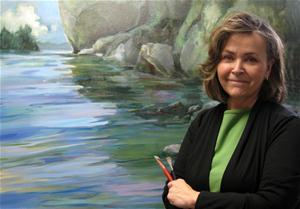
DPW Spotlight Interview: Sue Deutscher


Each week we will spotlight a different DPW artist who will give away one of their best paintings. 

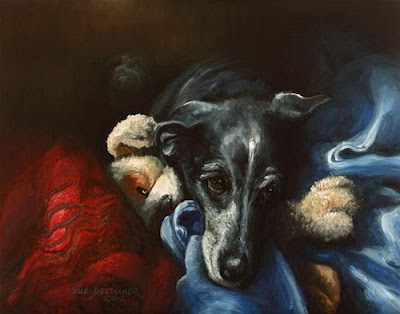
To enter to win Sue Deutscher's painting, Whippet and His Dog, go to DailyPaintworks.com and click on the Spotlight Giveaway button in the top-left corner of the website.

From Sue Deutscher's DPW Gallery page:
I find beauty and inspiration in the relationship between the pet and their owner. I've painted portraits of pets who have passed on and they are the most meaningful to the owner--and to me, as the artist. The portraits of pets who are still with us will be a permanent keepsake of the love that is shared. My paintings are like my children who, when set free, go on to live their own lives, and hopefully in homes where they are loved. 
Tell us a bit about how you first started painting.

When I was 27, I was walking past a hardware store that had a sign that said if painting supplies were bought there, they would include a free painting class, which was about to begin. I had the afternoon free, so I did just that and found my passion that day. The smell of the oil paint and holding the brush in my hand all felt very natural, as if I had done it all my life. That was 30 years ago, and it is still as exciting to me today as it was then.

SPOTLIGHT GIVEAWAY: Whippet and His Dog
(click here to see original image)

Enter to win by clicking the "Artist Spotlight and Giveaway" button!

Did you have any stops and starts in your painting career?

A few years ago, I felt like I had reached a level where I just wasn't getting any better. I felt frustrated with painting, and was drawn to photography. I learned much about light and when, after a couple of years, I painted again, I found that a lot of what I had learned in photography applied to painting. I learned how much colors affect each other and how important it is to have one color "pop." I also learned more about composition. It was great!

What mediums and genres have you experimented with? Which ones have "stuck" and which ones have fallen away? Which ones are you looking forward to exploring?

I have tried acrylic and worked quite a bit with pastels, but my favorite is oil. They all have their good evil twin sides, but for me, mixing oil colors is magical; the way blue and yellow combines to make green or the way adding green to red decreases saturation, without losing value. Though I don't like the mess and having to clean brushes, etc., mixing colors is a thrill.

Warming Up
(click here to see original image)

I don't feel drawn to exploring anything else right now, but you never know. I trust my instinct and if I'm drawn to something else, as when I was drawn to photography, then that is what I will do.

The lush darks and crisp lights of many of your paintings are reminiscent of the old, classical masters. Can you tell us more about how you developed your personal style?

What a wonderful compliment! Thank you! I love the mystery of chiaroscuro and for that, Rembrandt is my favorite. There are many on Daily Paintworks who could give Rembrandt a good run! I don't like too many colors on my palette, and prefer a tonalistic theme, so that it is harmonious throughout. I like to go with just the primaries and mix tertiaries. So my personal style would probably be called "keeping it simple."

I appreciate the phrase, "less is more," letting the viewer be more of a participant, rather than a spectator. I developed my style by studying other paintings and trying to emulate the realism, light and subjects that I like.

Border Collie
(click here to see original image)

What does procrastination look like for you? What techniques work to ensure that you make time for your art?

Procrastination looks like boredom to me. If I am avoiding painting, it must be because what I am working on is boring me. I should either finish it or call it a lost cause and move on to something else.

When I get lost in the painting and lose track of time, stop hearing anything around me, ignore any hunger pains and forget that I put a pot of coffee on, there is no procrastinating or having to "make time" for art. It is an obsession.

Heifer Class
(click here to see original image)

How do you generally arrive at ideas for your paintings?

I'm always looking at light, especially early in the morning or late in the evening when everything has that golden glow. I like to grab my camera and get that low angle sun falling on a sleeping cat or illuminating just the tip of a bowl of apples. Sometimes it seems like the subject is just an excuse to paint the light, and it doesn't even matter what the subject is. What is most exciting is dramatic shadows and highlights, but still being subtle about it.

How do you keep art "fresh"? What techniques have helped you avoid burnout and keep your work vibrant and engaging?

I try to paint a balance of what I think will sell and what I like to paint. Sometimes I give more one way than the other, and when I've been painting what I think will sell, I go the other way and just paint what I like.

I love painting animals, but I also like still lifes. When painting another dog or horse doesn't get me excited to paint, then I go for a still life, just for me. I may never list it or show it, but it's like a day off just to play.

Ground Hog's Day
(click here to see original image)

What do you feel you are learning about right now as an artist?

I imagine someone with a big, new home, walls blank, and how they want real art to look at and love every day, something that is meaningful and moves them emotionally. I offer prints, but I once heard that owning original art is like having a real apple pie, rather than a picture of a pie. Original art is rich and vibrant, and with the internet today and self-representing artists, people can afford the original instead of a "picture of the original." When the artist and art lover make that connection, it is completing the circle. What I am learning right now is how to complete that circle, which, to me, is what makes a piece "finished."

I would also love to paint an apple that looks like an apple rather than a tomato, which is what is on my easel right now. Needs more green, I think.

What makes you happiest about your art?

My art makes me happy when it goes to someone who really, really loves it. I would rather take less for a painting and have it go to someone who is thrilled to have it than not. It seems for every painting, there is someone who will love it, and my job is to find that person. You're out there, somewhere.

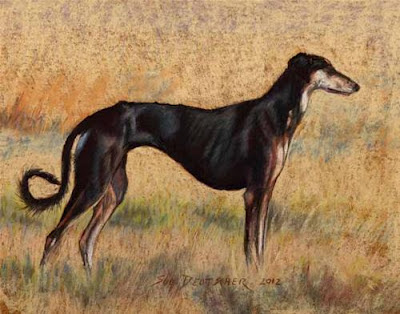
Reta, Saluki from Hawks View Hounds
(click here to see original image)

A painting is exciting for me when it tells a little story, or when the light is falling just right to make a delicate flower petal come out of a shadow, or it shows the calm expression of a sleeping dog next to a pair of hiking boots. When the viewer feels that same excitement, it makes a connection and I am happiest about that. I can feel when a painting "clicks" and having a complete stranger take a chance based on a jpg on their computer screen and order the painting, it's always a thrill.

Thanks, Sue!

©Jennifer Newcomb Marine

Thursday, June 7, 2012

DPW Spotlight Interview: Julie Ford Oliver

Each week we will spotlight a different DPW artist who will give away one of their best paintings.

To enter to win Julie Ford Oliver's painting, Doorway to Memories, go to DailyPaintworks.com and click on the Spotlight Giveaway button in the top-left corner of the website.

From Julie Ford Oliver's DPW Gallery page:
I was born in England and received a classical art education before coming to America. Working as an illustrator for the next 28 years provided the opportunity to work in many different styles and media. One of the most satisfying aspects of being a painter is the freedom it offers, allowing the imagination to delete, change and improvise. 
Tell us a bit about how you first started painting.

My earliest memory as a 3-4 year old child in England was choosing to color paper doilies, instead of joining the family to play games. As the years passed, this never changed. We would all be in the same room  - they would be playing cards - and I would be drawing or painting. I didn't realize it at the time, but my mother and father taught me to be very observant by continually playing"I Spy" on our frequent walks. Later, I would paint what I had observed from my memory. Still do it to this day.

SPOTLIGHT GIVEAWAY: Doorway to Memories

(click here to see original image)

Enter to win by clicking the "Artist Spotlight and Giveaway" button!

Did you have any stops and starts in your painting career?

Most women will answer this with a resounding YES!  Family means disruptions, but for me, family has been worth it. I was also lucky enough to work for a large agency which would mail me illustration assignments, because my husband moved a lot with his job.

Later, I had a five year period of helping my husband in his business and I didn't paint at all (for the first time in my life). I got depressed and the doctor wrote a prescription with a single word on it: PAINT!  That is when I started my fine art career.

What mediums and genres have you experimented with? Which ones have "stuck" and which ones have fallen away? Which ones are you looking forward to exploring?

I have tried most medias. I am happy doing anything art related. Put a brush in my hand and I am a happy gal!  My all time favorite was using egg tempera, because the process was absorbing and the completed painting, with its many layers, resulted in a harmony of coloration unlike any other media. Unfortunately, the floaters in my eyes started to increasingly make the detail work more difficult, so now I get my love of egg tempera satisfied by teaching it to some very talented artists. I notice some of the same layering techniques I loved in ET come through in my oil painting.

Fracturing the Flowers
(click here to see original image)

You do such a fantastic job of creating realism with extremely loose, but colorful brush strokes. Any insights into how you developed this skill?

I think good drawing is the foundation for realism and I had that drilled into me in art school. BUT - I had to re-learn color. By nature I am a tonalist... I come from the foggy shores of England! Living in the fabulous Southwest opened my eyes to color. I paint plein air and seeing colors with no moisture to "blue them down" was a learning curve I had to climb. I do believe pushing color can be taught. Funnily enough, I am still attracted to the gentle variations of layers of misty, blue/green hills receding in space.

The Skill? The loose method of painting was a skill I set out deliberately to acquire. I noticed when I was outside painting fast to capture the essence before the light changed, my work was more flowing, so I started to set the timer for my still life paintings. I would give myself 20 minutes at a time, stop, evaluate and set the timer again. It really worked, but not overnight.

Mountain Meadow Flowers
(click here to see original image)

What does procrastination look like for you? What techniques work to ensure that you make time for your art?

I procrastinate about a lot of things, but never my work. I have to be sick to procrastinate about that. I admit to getting rather grumpy when I have to take care of other necessary disruptions to my painting time. That is when my husband asks, "Aren't you going to the studio, dear?" He knows a Studio Julie is a Happy Julie.

What works for me? I find that calling my studio time "work," never, painting time. I did the same for my illustration career, but once I started working out of my home everyone had demands on me. I came up with a plan which worked great. I would dress dress for work, say goodby to everyone and I would go out of the front door... then walk round to the back and let myself in. The kids and husband got the point and never interrupted my working time. I have found that a lot of people presume when you "paint" that you can do lunch or shopping, you know, the fun things they would never ask you to do during the day if you worked in a, quote, "proper job!"

Also, I teach 26 artists at the Guild so that is a great organizer of time, all on its own.

How do you generally arrive at ideas for your paintings?

Usually in bed during that lovely time when you are half asleep, drifting towards opening your eyes... I say my prayers and go through my list of people needing help, and then I start deciding what I feel like painting. I actually get excited and look forward to this routine. I have a very visual memory and can mentally create a painting, adding and removing objects until I'm satisfied.

I also have a notebook I jot ideas down in. I am a big believer in thumbnail drawings to explore design and concept. I will walk pass something and the color or placement will attract my eye. I recently did some tin cans, lemons and a red colander which had caught my attention when they were waiting to be put away.

Lemon with Cans
(click here to see original image)

How do you keep art "fresh?" What techniques have helped you avoid burnout and keep your work vibrant and engaging?

For many years I have had this vision of a style -  how I wanted my paintings to look -  but could only achieve it in little areas. It was only when I went to painting every day that I started to see it taking form. Even then it was difficult to do, as the pressure of producing a painting on top of teaching and commissions rattled my insecurity cage. I would record when it happened and try to understand why it wouldn't work other times. I named it Fracturing.

It is a technique I am still developing and I started to explore it in the classes I teach. Bit by bit, all the guild artists have seen the development and have been very encouraging. All of a sudden in the last month or so, it has been flowing quite naturally and the areas I am having problems with are fewer and fewer. The response from other artists in the blogging world has been very encouraging... some have been enthusiastically articulate in support of it.

It is very exciting for me to develop something I have not seen done in quite the same way.

What do you feel you are learning about right now as an artist?

You mean besides the computer work necessary in this blogging world? That has been difficult and I have to thank my wonderful daughter for her help in that area.

Fracturing, fracturing, fracturing. This is the technique that has been evolving in my work over a long period of time. Now, it is constantly occupying my mind and hand.

I think artists are lucky because painting is an ongoing, lifelong learning experience. We are all students in that regard, for our entire art lives.

Lemonade
(click here to see original image)

What makes you happiest about your art?

I am aware God gave me the desire and  fortitude to create. I choose teaching and painting to express my gratitude with joy.


© 2012 Jennifer Newcomb Marine

Jennifer Newcomb Marine is the Marketing and Community Manager of Daily Paintworks. She's an author and blogging and marketing coach.


Thursday, May 31, 2012

DPW Spotlight Interview: Vinayak Deshmukh

Each week we will spotlight a different DPW artist who will give away one of their best paintings.

To enter to win Vinayak Deshmukh's painting, Repairs Before the Tide Comes In, go to DailyPaintworks.com and click on the Spotlight Giveaway button in the top-left corner of the website.


From Vinayak Deshmukh's DPW gallery page:


I am an artist from India. After graduating with a degree in engineering, I longed to return to my brushes. For the last seven years, I have been taking my art seriously. My work has been seen in state and national level juried exhibitions and today my paintings are in collections in India, USA, UK and Dubai.


Tell us a bit about how you first started painting.

I have been painting since I was a kid. I was fascinated by things such as railway locomotives, coaches, boats, etc. and would draw them endlessly from memory. That was when my parents felt that I had a genuine flair for drawing and encouraged me to pursue it as they thought it was time well spent.

In school, I would participate in various drawing and painting competitions and often win prizes. As I grew up, however, priorities changed and I had to concentrate on my studies and ensure that I got into a good professional course.

SPOTLIGHT GIVEAWAY: Repairs Before the Tide Comes In


(click here to see original image)

Enter to win by clicking the "Artist Spotlight and Giveaway" button!

In college I would often spend time in the Architecture library. This rekindled my interest in art and I started copying images from books there to learn the basic techniques of watercolor painting. After getting a degree in engineering and settling down in my job, I still felt the same inclination towards art. In the last seven years or so, I have been painting seriously and hopefully making progress...

Did you have any stops and starts in your painting career?

Painting for me was only a pastime up until a few years ago. In school it was mostly an activity to be cultivated in the summer vacations.

The longest break I had was for about 5 or 6 years, when I was in high school and then in junior college. After engineering college, I could not paint for a couple of years again, as the priority then was to stop changing jobs and settle down in one I liked. For the past six years or so, I have been painting more or less regularly.

What mediums and genres have you experimented with? Which ones have "stuck" and which ones have fallen away? Which ones are you looking forward to exploring?

I have been using pencil and watercolour most of my life. In the last few years I have tried to explore oils and charcoal too. Each of them has unique characteristics that appeal to me. I love the fluidity and transparency of watercolour and also the impasto nature of oils. I haven’t tried many other mediums. I love works done in pastel and hope to add them to my repertoire someday.

As far as genres are concerned, I like all the three major ones in realistic painting – portraiture, landscape and still life. I haven’t done much of animal portraits though and would love to try my hand at that.

As If Nothing Has Ever Happened
(click here to see original image)

There's such a wonderful quality of delicacy and light in your work. Can you describe your process for making sure the whites are "just bright enough" to look right?

Thank you for the compliment. Yes, light and its effects are definitely the most important things I try to capture in my paintings. The light temperature, intensity and contrast are crucial in creating the mood.

I make many value sketches before I start a painting - sometimes as many as 10 or 12. They help me finalise my value scheme and decide upon my lightest lights and darkest darks. By placing suitable values around a certain shape, I can ensure that it appears just as bright or as dark as I want it to. All these things can be worked out much easier in a value sketch. They are even more useful with watercolours because of the limited extent to which watercolours can be corrected.

Adasa Rooftops
(click here to see original image)

What does procrastination look like for you? What techniques work to ensure that you make time for your art and actually start painting?

Procrastination is a scary guest and doesn’t go away soon once it comes to stay. So I need to be really vigilant against getting lazy.

I have a day job and am often quite tired in the evening to take up any serious creative work. I therefore paint routinely in the mornings. I ensure that I do at least 3 hours of serious painting every morning before I start for work.

On Sundays and holidays, I start painting even before sunrise so I can paint for as much as 6 hours without compromising on family time. It’s not necessary that I come up with a finished painting every day, but I ensure that I follow this routine at least 4 days a week. Sometimes, depending on my energy levels, I do value sketches and other preparation for a painting in the evening. This way I ensure that I can directly start the final painting the following morning.

How do you generally arrive at ideas for your paintings?

I am always on the lookout for new ideas and subjects to paint. Some of the most beautiful subjects present themselves in the most unexpected of places. I work both en-plein air and indoors.

When working indoors, I use photographs and outdoor sketches for reference. If I do not like a scene as it is, I edit out certain things and add others from my memory and imagination, but ensure that I retain the essential character of the scene.

I often make field sketches hoping to convert them into serious paintings someday. Alongside these sketches, I also take down notes regarding the direction of light, the general atmosphere and anything else that I found unique about the place. This information comes in handy to recreate the mood, especially when there is a long gap between doing the sketch and the final painting.

Anxious
(click here to see original image)

How do you keep art "fresh"? What techniques have helped you avoid burnout and keep your work vibrant and engaging?

It is very important for me that I understand my subject thoroughly and know exactly why it appeals to me. I then try to communicate the same with my brushes.

I find inspiration in the works of other, more accomplished artists. I feel trying out different mediums and genre once in a while helps to avoid stagnation. I love to travel and take lots of photos for future reference. A change in subject matter gives me new ideas and suggests the need to explore newer techniques of handling paint.

I make sure that I take up all serious painting only when I am fresh, energetic and in a peaceful mental state. I believe that a dull and bored mind will result in dull art. A bit of yoga and meditation before painting is really helpful.

There are occasions when I do not feel very enthusiastic and excited about putting paint on paper. At such times I do other not-so-interesting activities, which reminds me of the pleasures of painting that I am missing. This makes it easier to get back to the easel.

Plate with Fruits
(click here to see original image)
What do you feel you are learning about right now as an artist?

I guess right now I am learning a lot about the use of colour. Mixing the right colours is very effective in communicating a certain mood or feeling. One other thing I am definitely learning is edge control and the wonderful effects one can achieve with a judicious choice of edges.

What makes you happiest about your art?

The fact that I an enjoying every moment of it!

Thanks, Vinayak!


© 2012 Jennifer Newcomb Marine

Jennifer Newcomb Marine is the Marketing and Community Manager of Daily Paintworks. She's an author and blogging and marketing coach.


Friday, May 18, 2012

DPW Spotlight Interview: Clair Hartmann

Each week we will spotlight a different DPW artist who will give away one of their best paintings.

This week we are spotlighting Clair Hartmann, who is giving away her beautiful painting Summer Marsh, which you can see below.

To enter to win this painting, go to DailyPaintworks.com and click on the Spotlight Giveaway button in the top-left corner of the website.

From Clair Hartmann's DPW gallery page:
Clair Hartmann began daily painting in 2007. Her work can be found in private collections, institutions and numerous galleries around the globe. Her Downtown Dog Project (100 dogs in 100 days) is now available in book format.

Tell us a bit about how you first started painting.

When I went to the Art Institute of Ft. Lauderdale to study graphic design, they offered painting as part of the required curriculum, so I started there. I remember sitting in the hallway in my dorm room first trying oil paints, looking at the muddy brown and gray mess, thinking, "How does anyone paint with this stuff?" Eventually, I figured it out.

Mutt

(click here to see larger image)

My first real painting was of my son, which I completed in one night for a grade in the morning. I got an A and it was on display at the school for a few weeks. I'm not sure how I got from a muddy mess to a legible painting, but I did somehow!

Did you have any stops and starts in your painting career? 

Yes, my painting has been sporadic up until four years ago, when I seriously decided I wanted to stop my graphic design company and paint for a living. The longest stop ever was for about 8 years, when I quit drinking 16 years ago. Drinking became so much a part of my painting, it seemed impossible to separate the two, but painting pulled me back in.

When I was ready to get serious, I started doing a painting a day and although completing a painting a day was sometimes not possible, it was my goal. About a year into doing a painting a day, I didn't feel as if I was truly enjoying it. I knew it was what I needed to do with my life (my path, calling, etc.) but for some reason, I wasn't enjoying the process.

Eventually, I became somewhat fearless... not so focused on mixing colors, thickness of the paint, linseed or thinner, etc. and most of all, not afraid to make mistakes. It wasn't until then that I could fully enjoy just sitting and painting. Now it's evolving into a meditative process for me.

Fritz (commission)

(click here to see original image)
I guess it's like learning to walk, in the beginning you are so focused on the mechanics, you can't fully enjoy a stroll. Then when it becomes second nature, you don't even have to think about it. Then not only can you walk and enjoy, you even can skip.

What mediums and genres have you experimented with? Which ones have "stuck" and which ones have fallen away? Which ones are you looking forward to exploring?

I really love oil paint with a mix of 1/2 and 1/2 odorless thinner and linseed. I'm starting to use Gamblin Radiants and just love them. I have found that Williamsburg burnt sienna is opaque and Windsor and Newton is transparent, which is good to know because I use a lot of it painting dogs.

I don't use black anymore, using a mix of ultra marine and burnt umber instead (or orange or raw sienna for variations) to create a rich black in which you can lean to a warm black or cool black easily by adding more or less of either color. For larger brushes, Princeton are the best and worth every penny. For smaller, Rosemary and Co. last the longest.

As far as subject or genre, I like painting other subjects to stay fresh, but I always come back to the dogs and I have been really enjoying imaginary realism lately. I have had people say to me "Don't get pigeonholed into painting dogs," and I find it funny that no one ever says "Don't get pigeonholed into painting figures or still life..." I love painting dogs and I love my paintings of dogs and if that's what I get known for, it's fine with me.


King Martin

(click here to see original image)

I have no idea how you do this, but your dog paintings in particular do such an amazing job of capturing each animal's essence that I actually feel as if I could reach out and pet the dog! Thoughts?

I think as a painter, when you feel passionate about a subject, you tend to want to communicate it in your paintings. Dogs add so much to our lives and when I see an essence that pulls me in, I want to recreate it in my painting.

Eyes are so important in painting dogs. Eye contact is how we communicate with them. They watch everything we do, anticipating every move we make. We know when we look into their eyes, they love us and it makes us love them, it connects us.


Big City Dog

(click here to see original image)

What does procrastination look like for you? What techniques work to ensure that you make time for your art? 

When I start randomly cleaning the house, I know I'm avoiding a painting.

So I start cleaning the studio and organize to stay in the zone and not avoid. I lay out a canvas ready to paint and my paints and brushes and when I get up early in the morning, the first thing I do is start painting. It helps to have music in earphones to get in a meditative state.

How do you generally arrive at ideas for your paintings? 

Just thinking, a lot of it. Sometimes preparation for a painting takes longer than the actual painting. I always have ideas going on in my head of what I want to do. I love metaphors and try to illustrate around a metaphor that tends to stay awhile in my brain. I use photoshop and move around photos with other photos to get an idea of how it'll look.

How do you keep art "fresh"? What techniques have helped you avoid burnout and keep your work vibrant and engaging. 

I try not to paint just dogs and go from a lot of other subjects. When I feel like taking a break, I do and try not to feel guilty, when I'm ready, I'll start to miss it and be painting again.

SPOTLIGHT GIVEAWAY: Summer Marsh 

(click here to see a larger image)


Enter to win by clicking the "Artist Spotlight and Giveaway" button!                  


What do you feel you are learning about right now as an artist? 

Color and brush technique. Last year I took a class from Susan Hecht and she introduced me to correct color and pushing color. It blew my mind and was very confusing at the time, but now I think I'm getting the hang of it and really enjoying the challenge.

As far as brush technique, I'm trying not to be so controlling and letting the stroke have a personality. Trying to keep a realistic style, balancing it with a painterly stroke and allowing mistakes. At a recent lecture I attended, Charles Movalli said "Mistakes are our signature..." Love that!

What makes you happiest about your art? 

That I'm doing it sober and really enjoying it.

Thanks, Clair!


© 2012 Jennifer Newcomb Marine

Jennifer Newcomb Marine is the Marketing and Community Manager of Daily Paintworks. She's an author and blogging and marketing coach.


Friday, May 11, 2012

DPW Interviews: Mary Maxam


From Mary Maxam's DPW gallery page:
A native of Idaho, Mary Maxam finds inspiration for her paintings in the beautiful scenery and gardens of the Northwest. She is a graduate of Boise State University and has studied in many professional workshops, teaching art for many years herself. Mary's work has shown in many juried national exhibitions and has contributed both painting and written work for book and magazine articles on painting and design.
Tell us a bit about how you first started painting.

I've been drawing and painting all my life it seems. I started to focus more on wanting to be an artist and/or teach art while in high school. I always liked crafts too, along with all the materials and processes involved with the visual arts.

Iris Garden
(click here to see original image for sale)

Did you have any stops and starts in your painting career?

When I first began teaching high school art, time was so hard to find. I knew it would be important to try to continue my own work along with teaching. That turned out to be harder than I thought. I sometimes just didn't have the energy for real development of work at the end of a teaching day.

However, I did over time, get into a pattern of evening painting, and tried to get in an hour or two of either painting or drawing on most days. Doing so helped me to continue to be an artist in my own right.

What mediums and genres have you experimented with? Which ones have "stuck" and which ones have fallen away? Which ones are you looking forward to exploring?

I painted in watercolor for many years and loved the variety of ways watercolor can 'look.' It was also a pragmatic decision, because I just didn't have a realistic space for oil painting. About 10 years ago, the galleries I were with began asking more and more for oil, which I'd wanted to explore myself. So, I took it as a sign to make a change and primarily work in oil.

I also have a larger and better space now for working. While teaching, I both experimented with and taught using a variety of mediums, but for for my own work watercolor and oil 'stuck'.

His Best Side
(click here to see original image)

One of the first words that comes to mind for your art is lush. What have you learned over the years about accurately reflecting the intense colors you're seeing in your subject matter on the canvas? 

I love that compliment because I do frequently have that reaction to the subjects I'm attracted to. I want to paint their lushness somehow. I think one thing I keep relearning is that sometimes less is more. If all the colors on the wheel are on the painting, they all compete for attention. If I make one or two colors the stars of the show, so to speak, then I can use compliments or analogous colors to help them 'say more.'

I've been recently trying to use more colorful grays to contrast with pure tones, I enjoy that a lot. Also, transparent color next to opaque color is something I love to contrast and it's effective for me.

Fabulosity and Her Court
(click here to see original image for sale)

What does procrastination look like for you? What techniques work to ensure that you make time for your art?

I rarely have a time when I don't want to paint, so I guess I'm lucky that way. I tend to have the opposite problem, jumping into a painting before I've considered my aim long enough.

When the issue comes up, I usually just go make panels or clean brushes - just getting into the studio or where the paints are helps. One things leads to another and I find myself with a brush in hand. I procrastinate more in getting the laundry or dusting or organizing done - ha!

How do you generally arrive at ideas for your paintings?

I use photos, sketches and plein air work to develop paintings. It's not as much the subject for me, as the way light or color catches a particular subject. My eye locks onto something and then I try to visualize an idea for a painting from that. I am usually able to find that spark with flowers, landscape or fly fishing figures on a stream, subjects in a natural setting.

Drift
(click here to see original image for sale)

How do you keep art "fresh?" What techniques have helped you avoid burnout and keep your work vibrant and engaging?

I like to rotate several subjects, as my blog followers can attest to! When my work isn't engaging to me, I try asking myself, What do you want to see? (as opposed to what's in front of me).

When I work on a painting that has been freshly toned and the surface is still wet, the opaque color stroke that goes over the top of it, continues to be an interesting surprise. It's a stepping off point and not something that you can completely plan or explain.

What do you feel you are learning about right now as an artist?

I really need to pre-plan compositions more thoroughly instead of diving in too quickly. Especially, with larger works, which I have been trying to find time for! I'm still on that path to finding my own voice and hope to continue and refine that search.

Window Box Floral
(click here to see original image for sale)

What makes you happiest about your art?

There are those times when a painting just flows from brain to brush and there is no 'second guessing' -  it just feels like Aaahhhhhhh... so great! And when I have a painting that 'clicks' with people so that they feel I've caught something personal for them!

I like the constant striving and problem solving too - there's always another painting around the corner....

Thanks, Mary!


© 2012 Jennifer Newcomb Marine

Jennifer Newcomb Marine is the Marketing and Community Manager of Daily Paintworks. She's an author and blogging and marketing coach.