Thursday, July 19, 2012

DPW Spotlight Interview: Mariko Irie

Each week we will spotlight a different DPW artist who will give away one of their best paintings. 

To enter to win Mariko Irie's painting, Sunny Sunset Cliff, go to DailyPaintworks.com and click on the Spotlight Giveaway button in the top-left corner of the website.

From Mariko Irie's DPW gallery page:
Mariko Irie, a lifelong painter, was born and raised in Tokyo and currently resides in Santa Rosa, California. She has been in numerous solo and group shows and her work is collected privately and publicly throughout the U.S., Japan, England, Germany and Canada, including the Miasa Governor in Japan. She has been exhibiting in galleries for the past 22 years.
Tell us a bit about how you first started painting.

My mother watched me enjoying painting when I was in preschool and took me to a painting class when I was an elementary school. Up through high school, my media was oil pastel, which is very common for children - so was crayon, but I didn’t like it. I won prizes for my paintings.

When I was a high school, I got an oil paint set. I used to go out and paint by the river. I loved painting and drawing all the time, but I was not thinking I'd ever be a painter or an artist. One of the reasons why: my art teacher in high school was great - but the substitute who had just graduated from an art university came to teach us. She believed that only abstract painting was Art. She criticized my paintings so badly, I quit painting in class.

Sunny Sunset Cliff
(click here to see original image)

Enter to win by clicking the "Artist Spotlight and Giveaway" button!


Then I was became fascinated by the idea of becoming a designer. So I went to art school to prepare for the entrance examination for Art University and studied drawing and composition. I passed the examination for Musashino Art University in Japan and my major was Interior Design.

After graduating, I became an interior designer. The economy was a bubble at the time, so I was making great money. But after ten years, I felt something lacking in my life; there was a hole in my body. I quit my job and married, but that was not answer either.

It took me long time to figure it out. After I settled in Mendocino, I started painting again. Right before I turned forty years old, I asked myself: If I knew that I would die tomorrow, what would I want to do? 

The answer was painting.

Did you have any stops and starts in your painting career?

Galleries started to show my work in 1989 and since then, I have never stopped painting. I have two sons; the younger son was two years old in 1989, when I moved out from my ex-husband’s. First, I was taking classes at the college and the classrooms were my studios. When my sons started to go to school, our living room was my studio.

What is the next?
(click here to see original image)

Five years later, we moved into a bigger house and I got my own studio space. I worked on my art when they were at school and until they got driver licenses, I was their driver. I was happy to do so, because I wanted to enjoy them. It was precious time in my life and I knew it wouldn’t last forever. Now they have both graduated from universities and have their own lives.

What mediums and genres have you experimented with? Which ones have "stuck" and which ones have fallen away? Which ones are you looking forward to exploring?

In 1989, I took a printmaking class at the College of the Redwoods. I did etching, monotype and serigraph. During my first exhibition at the college, my etchings sold. So I took them to show at a gallery and they started to sell them. I felt so lucky.

In the late 70’s in Tokyo, I saw “American Super Realism” paintings. It was sensational. I was fascinated by these paintings. They were such a simple concept; the painters were painting exactly what they were seeing and they were somehow even more realistic than photography.

Sunset Time
(click here to see original image)

Then I took painting class with Bill Martin. He was a master Surrealism painter and an instructor of painting at the College of the Redwoods. I wanted to learn Super Realism technique from him. He passed away in 2009, but his family continues his website: http://www.billmartingallery.com/

At one point, I became allergic to oil paintings and all solvents, so I switched to watercolor. I've painted watercolor for over twenty years now. It’s an incredible media. If we try to control it, we end up losing control. But if we let watercolor paint itself, it creates a fascinating painting.

Three years ago, I moved to San Diego. The climate there is much dryer than Mendocino. My watercolor technique wouldn’t work well, because it would dry too fast. I joined the plein air groups and took water-mixable oils. I learned from other artists how to paint fast. It was a big challenge for me, but it was great, even with the struggling.

I’m having fun with water-mixable oils now.

Many of your paintings are set outside - at the beach, during sunrise or sunset. There's such a lovely quality of light in your art, as if we're actually seeing real sunlight. What can you tell us about you make your work look so true to life?

Thank you for saying that, it's a big compliment. Sunset, sunrise. The beautiful moment is so short. I can’t paint fast enough at the location itself - especially an 11” x 30” watercolor painting, which takes about a week to finish.

So I take photos. I spend time staring at the scene, trying to absorb the light, shadow and colors. Then I paint at my studio. When I start to paint, I don’t think of any one thing, I'm just in my painting world - and then - the painting is finished. From my experience, when paintings are done this way, they make the best ones.

Shoes
(click here to see original image)

What does procrastination look like for you? What techniques work to ensure that you make time for your art?

Procrastination: I can’t do it! It’s my nature. If I know that something should be done, I have to do it right away. Otherwise, it just sticks in my mind and I can’t do anything else. But sometimes, there are too many things to be done, so I just make a schedule and a check list.

What techniques work to ensure that you make time for your art?

Having a solo show at a gallery. That makes a good excuse for focusing on painting.

How do you generally arrive at ideas for your paintings?

A lot of times, I work from photos. When I’m staring at an image, I start to remember that moment. During other kinds of my paintings, for example, “Opening of Happiness,” I just think, “What is happiness?” and the image comes from that. Sometimes a gallery will have a group show with a theme. For instance, the last theme show I did was “Love Note” and I painted “Encounter” and “Art Lovers” for that.

How do you keep art "fresh?" What techniques have helped you avoid burnout and keep your work vibrant and engaging?

When I’m exhausted, whatever I see looks horrible, so I take a nap. That helps a lot. Or I might change the subject for my paintings or play on the surface of painting to create a new technique. It’s a part of learning the media all the time, a process that always stimulates me. Taking trips helps me a lot too. It takes my mind out from studio, then I come back renewed, with a vision.

What do you feel you are learning about right now as an artist?

I’m so lucky to be an artist, because I'll be learning forever. It refreshes my life all the time and now we have all this information through the internet. Art is forever and alive.


Daffodils Glow
(click here to see original image)

What makes you happiest about your art?

When my paintings come out better than I imagined. When people smile in front of my paintings, I’m very happy; it's like my paintings have brought joy to this world. When somebody falls in love with my painting and brings it into their home, that makes me so happy. I feel that I connected with them through my painting.

Thanks, Mariko!

© Jennifer Newcomb Marine

Thursday, July 12, 2012

DPW Spotlight Interview: Nancy Parsons

Each week we will spotlight a different DPW artist who will give away one of their best paintings.

To enter to win Nancy Parson's painting, River Walk - San Antonio, go to DailyPaintworks.com and click on the Spotlight Giveaway button in the top-left corner of the website.

From Nancy Parson's DPW gallery page:
I began a blog in the summer of 2010, as my husband Dave and I embarked on a 4,000 mile, six-week, artist sabbatical in our little pop-up camper. I began painting and posting each day on my blog at www.headondownthehighway.blogspot.com. Since returning, I have continued to paint and post as a daily painter of what I have coined Not-So-Still Lives. 
Tell us a bit about how you first started painting.

I began painting in kindergarten. As one of nine children, my art was the only way I could get noticed. Luckily my parents affirmed me with art lessons or there's no telling what I'd have done with my life.

I remember consciously deciding to be an artist at age six. By the time I graduated from high school, the thought of being a female painter in 1966 sounded way too scary. Out of fear of dying on the sidewalk from starvation, I studied commercial art in college.

Although I have always painted to some degree, taken scattered painting classes, and even won an award here and there; I really didn't start painting on a regular basis until a little over two years ago when my husband and I took off for 6-weeks in our pop-up camper. I began painting everyday and blogging. When we returned home, I was invited to do a one-woman show at a local gallery and sold enough work to pay for our entire trip. I was hooked and immediately signed up for a couple of workshops with two of my favorite artists (Carol Marine and Rene Wiley), joined several art organizations, bought and devoured every used art book I could get my hands on, and really began studying art.

River Walk - San Antonio

(click here to see original image)

Enter to win by clicking the "Artist Spotlight and Giveaway" button!

Did you have any stops and starts in your painting career?

Lots of them. When my kids were little I was painting in watercolors and participating in local art shows, painting wall murals, and doing commissions for neighbors. Life was going good, or so I thought, until my first husband suddenly walked out the door and my world and fine art dreams collapsed.

Out of desperation, I took a full time job in international banking, but after 5 years was bored out of my mind. I eventually went back to art school and graduated from the Art Institute of Houston in Advertising Design, and then started my own graphic design business in 1984. I was still painting here and there and taking a few workshops, but dying with desire to paint full time.

So, after another 26 years of raising a family and running my design business, I realized that time was ticking away and if I didn't figure out a way to make this happen, I would never get to be a painter. I made a commitment then and there to start painting nights and weekends. I made that decision over two years ago and can honestly say I am happier and more excited than I've ever been in my life!

Z-Zinnia Tops
(click here to see original image)


What mediums and genres have you experimented with? Which ones have "stuck" and which ones have fallen away? Which ones are you looking forward to exploring?

In the past, I have worked in many different genres and mediums including: watercolor, prisma color, scratchboard, gouache, airbrush, acrylics, pen and ink, charcoal, clay and silkscreen. For some reason, those mediums were not loud enough or loose enough to satisfy me. I longed for my work to be bolder and scream with intense color.

I now work exclusively in oils and love the flexibility and rich creamy texture of the medium. I currently work with pretty thin paint, but hope to learn to use thicker applications as I grow in my art. I usually only work with primary colors, plus white and umber, but lately have begun to explore other palettes and colors. This has made me feel like a kid in a candy store!

There's a wonderful relaxed, peaceful quality to many of your paintings. What can you tell us about how your compositions reflect your personal approach to life?

I think my compositions and subjects are intimate, honest and—hopefully—full of life and joy. I have a very active imagination; painting gives my inner child permission to come out and play. I like to paint in total quiet, so I can listen and hear. Painting is a meditation for me into the silence… like a prayer.

Shady Characters
(click here to see original image)

Once a painting feels complete, I become aware of something more wanting to be revealed. That's when I love to blog and share what my paintings have to say. I've never considered myself a writer, however I now feel my writing has as much to say at times as my paintings do. This has been an enormous step out of my fear and self-imposed limitations.

What does procrastination look like for you? What techniques work to ensure that you make time for your art?

Procrastination—if it comes looking for me—looks like fatigue or exhaustion. I know I push myself pretty hard and only get about 5-6 hours of sleep a night. I am a big believer in balance of body, mind and spirit. This is the secret I've learned which makes everything else I do work. Priorities come first.

I'm up early most mornings and in the pool by 5:00, followed by daily Mass, and then coffee with friends. By 9:00 a.m. or so, I'm ready to begin a full day of graphic design, followed by dinner with my husband and then—my playtime—painting and blogging.

How do you generally arrive at ideas for your paintings?

I carry my camera or phone everywhere I go and am always on the lookout for color, light, reflections and shadows to jump out at me. Road trips are a gold mine and I drive my husband crazy with my incessant screams to "Stop the car... let me out!" I find paintings everywhere, even out walking my dog.

If I ever run out of ideas, I take a trip to the produce and flower aisles in the supermarket. You wouldn't believe how many colorful characters jump up and down, begging to get into my cart.

How do you keep art "fresh"? What techniques have helped you avoid burnout and keep your work vibrant and engaging?

Bold strokes of clean color are the bomb!!!!  I try with all my might to put a stroke of paint down once and then leave it alone. Mud is the enemy to be feared and avoided at all cost.

Bend
(click here to see original image)

The key to avoiding burnout for me is always looking for something fresh and alive that excites and challenges me to paint, before I show up at the easel. I try to work loose and let parts of my tinted red canvases peek through here and there. I think these are major keys to help keep my paintings alive. If I start to get tight and fussy, I'll wipe the whole painting off and start over. There really are no mistakes in painting, just discoveries. Walking away from a painting—even before I think it’s finished—is my goal.

What do you feel you are learning about right now as an artist?

I am learning how to see, hear and feel on a deeper level... letting go and giving myself over in trust. I believe artists are all little brushes in the hand of the master Creator himself. He uses us as His instruments to express and share His love in the world. It's not always easy being a brush… but what the heck… someone has to do it. :-)

Rainy-Day Sunshine
(click here to see original image)

What makes you happiest about your art?

I am happiest with my art when I am feeling the most vulnerable—and yet to my utter surprise—finding that vulnerability somehow opens portals that communicate and resonate with others.

Anaïs Nin, a French-Cuban author once said, "Life shrinks or expands in proportion to one's courage."  I believe painting demands tremendous courage just to show up, but rewards courage with tremendous joy, satisfaction, and an intense appreciation and humble gratitude for the precious gift we call life.

Thanks, Nancy!

© Jennifer Newcomb Marine

Thursday, July 5, 2012

DPW Spotlight Interview: June Rollins

Each week we will spotlight a different DPW artist who will give away one of their best paintings. 

To enter to win June Rollin's painting, Dreamscape No. 153, go to DailyPaintworks.com and click on the Spotlight Giveaway button in the top-left corner of the website.

From June Rollin's DPW gallery:
June Rollins is a signature member of the Southern Watercolor Society and Watercolor Society of North Carolina. Her artwork has received national recognition and numerous awards. She teaches Dreamscaping with June Rollins workshops in watercolor and alcohol inks. 
Tell us a bit about how you first started painting. Did you have any stops and starts in your painting career? 

My biggest “stop” happened before I ever really started. In 1972, I told my high school guidance counselor I knew I wanted to be an artist. She enrolled me in 9th grade Art. The first day, I was so intimidated by what the teacher said would be required of us, I ran to the guidance counselor’s office immediately after the class and told her I had been wrong, “Art's not for me, I think it's boring.” The truth was, I was afraid I would lose my B+ GPA and stopped before I started. That decision began my 17 year detour away from my heart’s desire.


Dreamscape No. 153

(click here to see original image)

Enter to win by clicking the "Artist Spotlight and Giveaway" button!


In college, I poured over the course handbook and wanted so badly to major in art, but didn’t think I had what it took. Again, fear won.

I took up photography as a hobby in the early1990’s and soon a desire to paint from my photographs emerged. A friend introduced me to watercolor by letting me use some of her paper and paints. I bought a Grumbacher student kit, checked out library books and videos and dabbled off and on for about a year. Soon, other life choices and responsibilities took precedence and time for art was squeezed out.

My breakthrough came in October of 1999 with the Y2K scare. I woke up one morning and thought, if the world is going to end, I would at least like to take a beginner watercolor class. I enrolled in a 10-week course at a nearby community college. Thankfully, I had an encouraging teacher and have not stopped painting since.

What mediums and genres have you experimented with? Which ones have "stuck" and which ones have fallen away? Which ones are you looking forward to exploring?

I began in watercolor because it happened to be what I was introduced to first. I doubt I would have chosen it had I known it is considered by many to be the most difficult medium. I didn’t know any better and fell in love with it.

Fresh-Picked Daffodils
(click here to see original image)

I’ve mostly worked from my photographs and very early on was drawn to painting houses. I began getting requests for commissioned house portraits and used an opaque projector to save sketching time and for perspective.

My use of the opaque projector is falling away. Now, I’m wanting to sketch loosely from life or paint intuitively with no sketch.

In 2009, I had a strong desire to try other mediums via one-day introductory workshops. One of the mediums I tried, I had never heard of, alcohol inks. During that workshop it was like my inner child artist had finally been let out to play. All around me other artists were manipulating the inks with brushes, making impressive representational works, but I had a strong resistance to even picking up a brush! All I wanted to do was drop ink on the paper and observe what happened. Afterwards, through a spirit of experimentation and play the Dreamscaping theme emerged.

I began getting requests to teach and the instructor from that one day workshop gave me her blessing, saying I had developed my own style. Plans for my first instructional DVD, Level 1 Alcohol Ink Dreamscaping With June Rollins™ are now being made.

More important than choice of medium for me is the dreamscaping spirit I want to nourish and incorporate into all my art making. I now have a desire to dreamscape in watercolor, watercolor inks, oils and pastels.

Flower Power No. 6
(click here to see original image)

You're an accomplished watercolorist and you've also created bold, beautiful work using alcohol inks. What can you tell us about the differences in setting up compositions for each medium? What pulls you to either one? 

Many of my watercolors have been representational and were created from my photographs. Working in this manner requires more planning and preliminary set-up. It’s like putting together a difficult puzzle. It’s great when it all comes together and you feel a high degree of accomplishment.

You can work intentionally with alcohol inks too, but the Dreamscaping process I’ve developed is intuitive, using no brushes or pre-planned sketches. One of my students described it best, when she said, “When I pick up the ink bottle and begin dreamscaping, any tension I was feeling, begins draining away.”

How I’m using alcohol inks is influencing how I watercolor. My style is becoming looser. I’m having more fun, without trying so hard as I have in the past.

What does procrastination look like for you? What techniques work to ensure that you make time for your art? 

In the past, procrastination looked like a bag of Oreo cookies I had to open and eat or a load of laundry I had to start before I could begin to paint. Procrastination was my old friend, fear. We’ve just gotten used to each other. She doesn’t hold me back like she used to :-)

Dreamscape No. 143
(click here to see original image)

Competition deadlines have helped me. Not getting that art degree when I was younger made me want validation by attaining signature membership in art societies. Something I’m still aspiring to, but it’s not the be all, end all it once was. Getting so many rejections along the way has make me more resilient.

Since last November when I joined DPW, I’ve been inspired by other artists’ work and have benefitted from adopting the daily painting practice of working small. I’m an early riser and love starting the day Dreamscaping. Do I paint everyday? Well, maybe not on paper, but in my heart and mind I do.

How do you generally arrive at ideas for your paintings?

Just about everything I see, I’m interpreting into a painting. I’ll never be able to paint all that I want to paint which is one of the reasons my love for photography continues.

How do you keep art "fresh?" What techniques have helped you avoid burnout and keep your work vibrant and engaging? 

In 2009, I was experiencing a growing dissatisfaction with my art which is why I was prompted to try other mediums. Experimentation and play came to my rescue. Specifically, experimenting with alcohol inks revitalized my art making. It is such a fluid, forgiving medium.

What do you feel you are learning about right now as an artist? 

I’m learning the less I try to control or force a preconceived outcome, the more soul-deep satisfying the creative process. I believe I’m learning joy. I’m noticing this joy I experience when creating, sometimes transfers to the viewer which seems to complete the circle.

Dreamscape No. 69
(click here to see original image)

What makes you happiest about your art? 

That I’m doing it. That fear didn’t win. I love experiencing the creative process and inspiring others to get in touch with their own creativity; either with how my art makes them feel or offering art instruction.

Thanks, June!

© Jennifer Newcomb Marine

Thursday, June 28, 2012

DPW Spotlight Interview: Angela Moulton

Each week we will spotlight a different DPW artist who will give away one of their best paintings. 

To enter to win Angela Moulton's painting "Chickadee with Blossoms, No. 2," go to DailyPaintworks.com and click on the Spotlight Giveaway button in the top-left corner of the website.

From Angela Moulton's DPW gallery:
Angela Moulton has been a professional artist for nine years.  She specializes in oil painting and is inspired and paints still lifes, nature, animals, children, interiors and landscapes. Angela splits her time between Illinois and Idaho. 
Tell us a bit about how you first started painting.

I’ve always been extremely creative. I was raised in a home where creativity was encouraged. My father is an engineer and physiologist and my mother a designer. We always had a lot of stuff at our house - stuff for building forts, making art, decorating cakes, sewing, wood projects, science experiments, etc. I was the oldest of five and would involve my siblings and the neighborhood children in my creative endeavors.

Chickadee with Blossoms, No. 2

(click here to see original image)

Enter to win by clicking the "Artist Spotlight and Giveaway" button!

I had worked in the world of banking and finance throughout my adult life. In 2004, my sister told me about a lady selling her turtle’s paintings on eBay. I thought to myself, “If a turtle can sell paintings, then I certainly should be able to!”

Did you have any stops and starts in your painting career?

Like many things in childhood, the paints got put away after high school. But I’ve been painting almost daily since 2004.

What mediums and genres have you experimented with? Which ones have “stuck” and which ones have fallen away? Which ones are you looking forward to exploring?

I’ve experimented with acrylics, pastel, and oil paints. Also with graphite, charcoal, and ink. Oil painting is my specialty. I occasionally work with acrylics and still use graphite and ink for sketching.

I enjoy pastel immensely. I don’t see myself tiring of oils. But if I did, pastel would probably be my second choice medium. I prefer sketching in ink. I like the boldness, contrast, and permanence.

As far as genres, I paint mostly alla prima (wet on wet) and prefer still life, birds, and the figure. I sometimes paint landscapes. I’ve dabbled in abstract art and am inspired by many artists in this genre. I sometimes blur the lines between abstraction and real images in painting.

Geraniums on the Porch
(click here to see original image)

There’s such joy and whimsy in your strokes, which manage to be both strong, yet light-handed. What can you tell us about how you developed your particular style?

If you asked my husband, he would say my style completely fits my personality. I am not a fussy person and I move with confidence and sometimes boldness through life. On a more technical note, I plan a lot. I sometimes spend 90% of the painting process in the planning and prepping phase - sketching, mixing paints, and experimenting.

What does procrastination look like for you? What techniques work to ensure that you make time for your art?

First, procrastination looks like too much time spent online. It’s really a big time waster. Having an online business, I have to be online. I have a timer I keep on my shelf.  It’s one of those $3 ones you just turn. I use my timer whenever I need to set a time limit.

Untitled

Second, I have to set aside blocks of time for art. I can’t stop and start every 15 minutes. I use gloves, and painting clothes, smocks, painting pants, etc… I cannot switch back and forth between my paint time and the rest of my life without wasting a ton of time. I don’t answer the phone during this time unless it’s one of my family or a major business contact.

How do you generally arrive at ideas for your paintings?

My paintings are inspired by something I see or do, by feelings, memories, and photos from magazines, books, and art. I love going to art galleries and museums.

How do you keep your art “fresh”? What techniques have helped you avoid burnout and keep your work vibrant and engaging?

I try to mix things up often. If I get stuck in a rut, I just break out. I paint something entirely different. I aim to have my paintings not look alike. Personally, I can’t imagine ever getting tired of oil paints. But I am not above abandoning it for something else entirely – say collage or sculpture or even music – rather than burn out or get stuck in a rut. I would even go as far to say I would give up art entirely, at least for a while, rather than stay in a rut.

Strawberries from the Fridge
(click here to see original image)

I think my attitude keeps me away from burnout. Knowing I can and would quit, if I felt I should, actually prevents me from burnout – in an ironic sort of way.

On a less dramatic note, a new color tube of paint would probably do the trick.

What do you feel you are learning about right now as an artist?

The daily painting format is so important. I study a lot. But without practice, nothing gets better! Right now, my practice includes color experimentation, drafting skills – animals and birds, the figure, the portrait, architecture, and improving compositions.

Bluebird No. 14
(click here to see original image)

What makes you happiest about your art?

What makes me happiest is the freedom and individuality I access via my art. I used to work the financial markets hours, which aren’t bad. But with three children and two homes at opposite ends of the country (a ranch and city house), I have intentionally become an artist.

One day I asked myself what career would make me happy. I realized that art fit my life, and that I had life to give to the practice of art.

Thanks, Angela!

© Jennifer Newcomb Marine

Thursday, June 21, 2012

DPW Spotlight Interview: Colleen Sanchez


Each week we will spotlight a different DPW artist who will give away one of their best paintings. 


To enter to win Colleen Sanchez's painting, Ready or Not, go to DailyPaintworks.com and click on the Spotlight Giveaway button in the top-left corner of the website.

From Colleen Sanchez's DPW Gallery page:
I took a few watercolor classes and workshops with wonderful artists when I started painting in 2009, but I am mainly a self-taught artist. I just love the whole process of research, study and practice and enjoy painting the essence of nature - it seems to soothe something in my soul. 
Tell us a bit about how you first started painting.

It was somewhat by accident - painting never actually crossed my mind as something I would do. All my life I've had a passion for textiles; I spent about 15 years designing and creating high-end bridal, formal and career wear for personal clients. Anything to do with fibers, I loved, and was always looking for interesting finds to create with.

About 3 years ago, I stopped into an art store looking for some project supplies, noticed a cute little watercolor kit and on the spur of the moment, picked it up. I thought, no problem, I can just knock out a couple sketches and paint them. Well, I didn't get the result I wanted, kept trying, but just didn't understand these paints.

Ready or Not

(click here to see original image)

Enter to win by clicking the "Artist Spotlight and Giveaway" button!

I needed help and luckily I found it in the way of a watercolor class at the Honolulu Academy of Arts. I had a great instructor who really taught the basics and learned a great deal about the properties of watercolor pigments and water. Several light bulbs went off for me, one after another, during that 14-week course and I was hooked. I also quickly realized the importance of using only high quality paints, papers and supplies and use all archival materials.

I took a couple more classes and workshops before continuing to study and practice on my own.

Did you have any stops and starts in your painting career?

Well, as I'm a late starter, I haven't had any stops yet. I enjoy the learning and painting practice so much, I hope to continue this journey for the rest of my life. Some days I wish there were three of me so I could do more painting.

Heading Home
(click here to see original image)

What mediums and genres have you experimented with? Which ones have "stuck" and which ones have fallen away? Which ones are you looking forward to exploring?

Charcoal and graphite, of course, because I've been sketching off and on since I was a child. With painting mediums, I've explored several to find out what is right for me: watercolor, acrylic, pastel and most recently oil. My favorites are watercolor, oil and pastel.

Because I'm a bit of a late starter though, I know I need to narrow my focus in order to continue to improve my work. I think for the next while at least, I've determined a direction and my mediums of choice will be to work in watercolor and oil.  I'm looking forward to exploring landscape and still life in oils - working in a painterly style. One of the oil painters I admire right now is Bob Rohm, he does gorgeous landscapes and makes it all look so easy, but we all know it's hard work and practice and lots of trial and error. Right now, I'm trying out different supports and brushes to figure out what will be best for me as I develop my own style.

I'm very attracted to the luminosity that can be achieved with watercolor, so I want to continue to explore floral, foliage and maybe some ordinary urban subjects. I never seem to tire of flowers. Some people don't really have a lot of respect for floral painters. I'm not sure why, because flowers (especially if you focus closer in) are such wondrous and complicated natural treasures and NOT at all EASY to paint. Even for the artists who portray them in a more abstract style, it takes observance, practice and skill. So, I will persist with flowers, along with the fabulous foliage in abundance on these Hawaiian Islands.


White Waterlily
(click here to see original image)

I have many wonderful soft pastels, but I've put them away for a while so I can focus on watercolors and oils. Down the road I'll try the pastels again.

Your floral paintings capture such a fine level of detail that I'm not even sure how you can see what you do, much less recapture it on canvas or paper! What can you tell us about your particular painting process?

The florals may look like I work in a lot of detail, but truly, I do less and less of the fine detail as I move forward. I'm also near-sighted and usually paint without my glasses on, so I don't focus on details. I do love flowers - they provide so much inspiration to me, but once I have the paper and paints in front of me, I don't really see what I paint as a flower anymore.

Regardless, if I paint from life or from photo resources I am looking for the light first and then the shapes. I try to show those with color. I think my past experience with fabrics has taught me so much about color, that part seems to just come to me without even thinking. When I paint the flowers now, I challenge myself - get as much color down in one passage. It truly is a challenge because when you lay it down, it can look so dark, but watercolor lightens quite a bit when dry, so it takes a bit of chutzpah to use lots of paint. I try to go back in only for the shadow shapes and follow up with the background and maybe a tiny bit of detail at the center of interest.

When I'm finished, many times I'm surprised, hey, it does look like a flower. This way of painting has taken a lot of practice and I really do toss out some unredeemable pieces. I'm also trying to loosen up, but I still want the paintings to look like flowers, mainly because I tend to focus in on them individually or in very small groupings, rather than painting a bouquet with a profusion of flowers, where they can be done in a very painterly way.


Cardinals in the Volcano Forest
(click here to see original image)


What does procrastination look like for you? What techniques work to ensure that you make time for your art?

I've learned to use a day-timer. I'm sure like many others who try to take on too much responsibility for everything and everyone around them, eventually you realize you are not indispensable and your husband and or family can take on some of the chores. I try to paint at least 5 days a week now. I schedule my sketching, painting and photography times and try very hard to stick to it.

Most of the reading I do lately is also art related. The other time thief for me is the internet. Its great to have so much information at my fingertips, but I limit my computer time too, I really want to paint. I think I'm lucky that I can and better take advantage of my abilities while I have them.

How do you generally arrive at ideas for your paintings?

I used to dream ideas, but lately I have had some good ideas while in the shower and actually jumped out to write them down. I'm working on a few full sheet watercolor paintings from those shower ideas. I try to spend as much time outside as I can too, walking the dog, going to the parks and beaches and can't help seeing great things to paint all the time. There is so much beauty here, I don't think I'll ever run out of painting ideas.

How do you keep art "fresh"? What techniques have helped you avoid burnout and keep your work vibrant and engaging?

For me, I realized that if I decided to only focus on what may be considered highly marketable work, the quality I am after just will not come. If I painted on demand the love for it would go. I need to really enjoy whatever subject or idea I paint to have any hope of creating something I'm proud of. I do commissions as long as I'm interested in the subject.

Sometimes how we see things changes when you are so focused on the visual and what you may have just walked on by in the past suddenly becomes fascinating. That keeps me on my toes and constantly interested in ideas that may become a painting.

Promise Me
(click here to see original image)

What do you feel you are learning about right now as an artist?

I think I am learning to trust myself more. Not every painting works out, but you learn something from each attempt and grow from it. You take a step with each day and with each painting and learn to adjust your goals a little higher as you continue to progress. Paint what you love. Keep learning for the rest of your life.

What makes you happiest about your art?

I think the two things that make me the happiest are when I open my paintbox and see all those wonderful colors and how I can try to make them sing -- and when someone falls in love with one of my paintings and just has to have it. It is a great feeling to know you have touched someone with your work.

Thanks, Colleen!

© Jennifer Newcomb Marine

Thursday, June 14, 2012

DPW Spotlight Interview: Sue Deutscher


Each week we will spotlight a different DPW artist who will give away one of their best paintings. 

To enter to win Sue Deutscher's painting, Whippet and His Dog, go to DailyPaintworks.com and click on the Spotlight Giveaway button in the top-left corner of the website.

From Sue Deutscher's DPW Gallery page:
I find beauty and inspiration in the relationship between the pet and their owner. I've painted portraits of pets who have passed on and they are the most meaningful to the owner--and to me, as the artist. The portraits of pets who are still with us will be a permanent keepsake of the love that is shared. My paintings are like my children who, when set free, go on to live their own lives, and hopefully in homes where they are loved. 
Tell us a bit about how you first started painting.

When I was 27, I was walking past a hardware store that had a sign that said if painting supplies were bought there, they would include a free painting class, which was about to begin. I had the afternoon free, so I did just that and found my passion that day. The smell of the oil paint and holding the brush in my hand all felt very natural, as if I had done it all my life. That was 30 years ago, and it is still as exciting to me today as it was then.

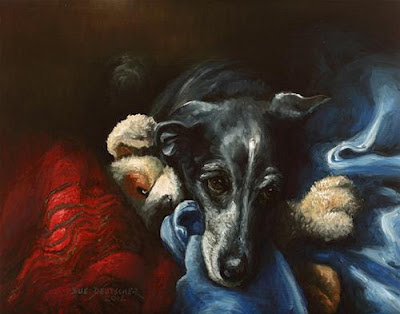
SPOTLIGHT GIVEAWAY: Whippet and His Dog
(click here to see original image)

Enter to win by clicking the "Artist Spotlight and Giveaway" button!

Did you have any stops and starts in your painting career?

A few years ago, I felt like I had reached a level where I just wasn't getting any better. I felt frustrated with painting, and was drawn to photography. I learned much about light and when, after a couple of years, I painted again, I found that a lot of what I had learned in photography applied to painting. I learned how much colors affect each other and how important it is to have one color "pop." I also learned more about composition. It was great!

What mediums and genres have you experimented with? Which ones have "stuck" and which ones have fallen away? Which ones are you looking forward to exploring?

I have tried acrylic and worked quite a bit with pastels, but my favorite is oil. They all have their good evil twin sides, but for me, mixing oil colors is magical; the way blue and yellow combines to make green or the way adding green to red decreases saturation, without losing value. Though I don't like the mess and having to clean brushes, etc., mixing colors is a thrill.

Warming Up
(click here to see original image)

I don't feel drawn to exploring anything else right now, but you never know. I trust my instinct and if I'm drawn to something else, as when I was drawn to photography, then that is what I will do.

The lush darks and crisp lights of many of your paintings are reminiscent of the old, classical masters. Can you tell us more about how you developed your personal style?

What a wonderful compliment! Thank you! I love the mystery of chiaroscuro and for that, Rembrandt is my favorite. There are many on Daily Paintworks who could give Rembrandt a good run! I don't like too many colors on my palette, and prefer a tonalistic theme, so that it is harmonious throughout. I like to go with just the primaries and mix tertiaries. So my personal style would probably be called "keeping it simple."

I appreciate the phrase, "less is more," letting the viewer be more of a participant, rather than a spectator. I developed my style by studying other paintings and trying to emulate the realism, light and subjects that I like.

Border Collie
(click here to see original image)

What does procrastination look like for you? What techniques work to ensure that you make time for your art?

Procrastination looks like boredom to me. If I am avoiding painting, it must be because what I am working on is boring me. I should either finish it or call it a lost cause and move on to something else.

When I get lost in the painting and lose track of time, stop hearing anything around me, ignore any hunger pains and forget that I put a pot of coffee on, there is no procrastinating or having to "make time" for art. It is an obsession.

Heifer Class
(click here to see original image)

How do you generally arrive at ideas for your paintings?

I'm always looking at light, especially early in the morning or late in the evening when everything has that golden glow. I like to grab my camera and get that low angle sun falling on a sleeping cat or illuminating just the tip of a bowl of apples. Sometimes it seems like the subject is just an excuse to paint the light, and it doesn't even matter what the subject is. What is most exciting is dramatic shadows and highlights, but still being subtle about it.

How do you keep art "fresh"? What techniques have helped you avoid burnout and keep your work vibrant and engaging?

I try to paint a balance of what I think will sell and what I like to paint. Sometimes I give more one way than the other, and when I've been painting what I think will sell, I go the other way and just paint what I like.

I love painting animals, but I also like still lifes. When painting another dog or horse doesn't get me excited to paint, then I go for a still life, just for me. I may never list it or show it, but it's like a day off just to play.

Ground Hog's Day
(click here to see original image)

What do you feel you are learning about right now as an artist?

I imagine someone with a big, new home, walls blank, and how they want real art to look at and love every day, something that is meaningful and moves them emotionally. I offer prints, but I once heard that owning original art is like having a real apple pie, rather than a picture of a pie. Original art is rich and vibrant, and with the internet today and self-representing artists, people can afford the original instead of a "picture of the original." When the artist and art lover make that connection, it is completing the circle. What I am learning right now is how to complete that circle, which, to me, is what makes a piece "finished."

I would also love to paint an apple that looks like an apple rather than a tomato, which is what is on my easel right now. Needs more green, I think.

What makes you happiest about your art?

My art makes me happy when it goes to someone who really, really loves it. I would rather take less for a painting and have it go to someone who is thrilled to have it than not. It seems for every painting, there is someone who will love it, and my job is to find that person. You're out there, somewhere.

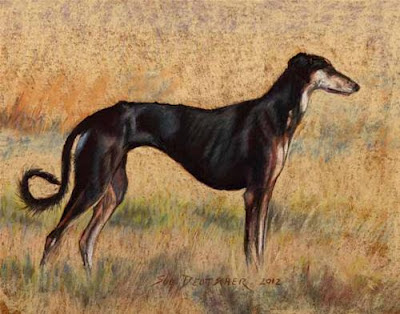
Reta, Saluki from Hawks View Hounds
(click here to see original image)

A painting is exciting for me when it tells a little story, or when the light is falling just right to make a delicate flower petal come out of a shadow, or it shows the calm expression of a sleeping dog next to a pair of hiking boots. When the viewer feels that same excitement, it makes a connection and I am happiest about that. I can feel when a painting "clicks" and having a complete stranger take a chance based on a jpg on their computer screen and order the painting, it's always a thrill.

Thanks, Sue!

©Jennifer Newcomb Marine

Thursday, June 7, 2012

DPW Spotlight Interview: Julie Ford Oliver

Each week we will spotlight a different DPW artist who will give away one of their best paintings.

To enter to win Julie Ford Oliver's painting, Doorway to Memories, go to DailyPaintworks.com and click on the Spotlight Giveaway button in the top-left corner of the website.

From Julie Ford Oliver's DPW Gallery page:
I was born in England and received a classical art education before coming to America. Working as an illustrator for the next 28 years provided the opportunity to work in many different styles and media. One of the most satisfying aspects of being a painter is the freedom it offers, allowing the imagination to delete, change and improvise. 
Tell us a bit about how you first started painting.

My earliest memory as a 3-4 year old child in England was choosing to color paper doilies, instead of joining the family to play games. As the years passed, this never changed. We would all be in the same room  - they would be playing cards - and I would be drawing or painting. I didn't realize it at the time, but my mother and father taught me to be very observant by continually playing"I Spy" on our frequent walks. Later, I would paint what I had observed from my memory. Still do it to this day.

SPOTLIGHT GIVEAWAY: Doorway to Memories

(click here to see original image)

Enter to win by clicking the "Artist Spotlight and Giveaway" button!

Did you have any stops and starts in your painting career?

Most women will answer this with a resounding YES!  Family means disruptions, but for me, family has been worth it. I was also lucky enough to work for a large agency which would mail me illustration assignments, because my husband moved a lot with his job.

Later, I had a five year period of helping my husband in his business and I didn't paint at all (for the first time in my life). I got depressed and the doctor wrote a prescription with a single word on it: PAINT!  That is when I started my fine art career.

What mediums and genres have you experimented with? Which ones have "stuck" and which ones have fallen away? Which ones are you looking forward to exploring?

I have tried most medias. I am happy doing anything art related. Put a brush in my hand and I am a happy gal!  My all time favorite was using egg tempera, because the process was absorbing and the completed painting, with its many layers, resulted in a harmony of coloration unlike any other media. Unfortunately, the floaters in my eyes started to increasingly make the detail work more difficult, so now I get my love of egg tempera satisfied by teaching it to some very talented artists. I notice some of the same layering techniques I loved in ET come through in my oil painting.

Fracturing the Flowers
(click here to see original image)

You do such a fantastic job of creating realism with extremely loose, but colorful brush strokes. Any insights into how you developed this skill?

I think good drawing is the foundation for realism and I had that drilled into me in art school. BUT - I had to re-learn color. By nature I am a tonalist... I come from the foggy shores of England! Living in the fabulous Southwest opened my eyes to color. I paint plein air and seeing colors with no moisture to "blue them down" was a learning curve I had to climb. I do believe pushing color can be taught. Funnily enough, I am still attracted to the gentle variations of layers of misty, blue/green hills receding in space.

The Skill? The loose method of painting was a skill I set out deliberately to acquire. I noticed when I was outside painting fast to capture the essence before the light changed, my work was more flowing, so I started to set the timer for my still life paintings. I would give myself 20 minutes at a time, stop, evaluate and set the timer again. It really worked, but not overnight.

Mountain Meadow Flowers
(click here to see original image)

What does procrastination look like for you? What techniques work to ensure that you make time for your art?

I procrastinate about a lot of things, but never my work. I have to be sick to procrastinate about that. I admit to getting rather grumpy when I have to take care of other necessary disruptions to my painting time. That is when my husband asks, "Aren't you going to the studio, dear?" He knows a Studio Julie is a Happy Julie.

What works for me? I find that calling my studio time "work," never, painting time. I did the same for my illustration career, but once I started working out of my home everyone had demands on me. I came up with a plan which worked great. I would dress dress for work, say goodby to everyone and I would go out of the front door... then walk round to the back and let myself in. The kids and husband got the point and never interrupted my working time. I have found that a lot of people presume when you "paint" that you can do lunch or shopping, you know, the fun things they would never ask you to do during the day if you worked in a, quote, "proper job!"

Also, I teach 26 artists at the Guild so that is a great organizer of time, all on its own.

How do you generally arrive at ideas for your paintings?

Usually in bed during that lovely time when you are half asleep, drifting towards opening your eyes... I say my prayers and go through my list of people needing help, and then I start deciding what I feel like painting. I actually get excited and look forward to this routine. I have a very visual memory and can mentally create a painting, adding and removing objects until I'm satisfied.

I also have a notebook I jot ideas down in. I am a big believer in thumbnail drawings to explore design and concept. I will walk pass something and the color or placement will attract my eye. I recently did some tin cans, lemons and a red colander which had caught my attention when they were waiting to be put away.

Lemon with Cans
(click here to see original image)

How do you keep art "fresh?" What techniques have helped you avoid burnout and keep your work vibrant and engaging?

For many years I have had this vision of a style -  how I wanted my paintings to look -  but could only achieve it in little areas. It was only when I went to painting every day that I started to see it taking form. Even then it was difficult to do, as the pressure of producing a painting on top of teaching and commissions rattled my insecurity cage. I would record when it happened and try to understand why it wouldn't work other times. I named it Fracturing.

It is a technique I am still developing and I started to explore it in the classes I teach. Bit by bit, all the guild artists have seen the development and have been very encouraging. All of a sudden in the last month or so, it has been flowing quite naturally and the areas I am having problems with are fewer and fewer. The response from other artists in the blogging world has been very encouraging... some have been enthusiastically articulate in support of it.

It is very exciting for me to develop something I have not seen done in quite the same way.

What do you feel you are learning about right now as an artist?

You mean besides the computer work necessary in this blogging world? That has been difficult and I have to thank my wonderful daughter for her help in that area.

Fracturing, fracturing, fracturing. This is the technique that has been evolving in my work over a long period of time. Now, it is constantly occupying my mind and hand.

I think artists are lucky because painting is an ongoing, lifelong learning experience. We are all students in that regard, for our entire art lives.

Lemonade
(click here to see original image)

What makes you happiest about your art?

I am aware God gave me the desire and  fortitude to create. I choose teaching and painting to express my gratitude with joy.


© 2012 Jennifer Newcomb Marine

Jennifer Newcomb Marine is the Marketing and Community Manager of Daily Paintworks. She's an author and blogging and marketing coach.