Thursday, August 30, 2012

DPW Spotlight Interview: David Forks

Each week we will spotlight a different DPW artist who will give away one of their best paintings. 

To enter to win David Forks' painting, "Sundown in the Valley," go to Daily Paintworks and click on the Spotlight Giveaway button in the top-left corner of the website.

From David's DPW Gallery page:
I have gotten a late start at it, but it has been my life long dream to paint for a living. I started painting daily in late 2008. Now that my children have grown and I have become a grandfather, the time to make that dream a reality is here. I am mainly a landscape painter and love the Texas Hill Country and the Trans Pecos, but will paint just about anything.
Tell us a bit about how you first started painting.

I have wanted to be a painter my entire life and was confident that one day I would make it happen. After 30 years, I was still saying one day I will become a painter. The loss of my oldest brother to cancer was a wake up call and provided the impetus for me do things I always wanted. I began in 2007 mainly as a weekend warrior, then in October 2008 I started my blog, started painting everyday and haven't stopped since.

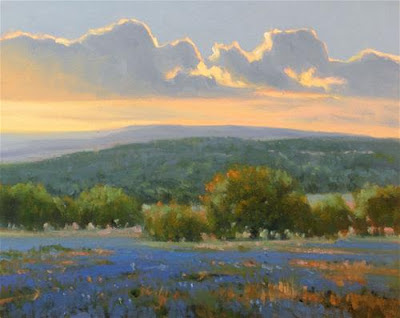
Sundown in the Valley
(click here to see original image)

Enter to win by clicking the "Artist Spotlight and Giveaway" button!

Did you have any stops and starts in your painting career?

Yes, I had always painted a little. Sometimes a few paintings in a year and sometimes a painting every few years. Before I started painting in 2007, I had gone through nearly a decade of almost no painting at all.

What mediums and genres have you experimented with? Which ones have "stuck" and which ones have fallen away? Which ones are you looking forward to exploring?

I started with watercolor when I was very young, then switched to acrylic for years while I rarely painted. When I became dedicated to painting in 2007, I again switched to oil. I still enjoy painting in acrylic on occasion and may experiment with mixed media acrylic/oil and possibly watercolor and pastel.

Early April
(click here to see original image)

You capture such beautiful, sun-drenched, wide open Southwestern vistas in your work. First, how do you find your settings? And secondly, how do you go about framing your compositions when you have so much "there" to choose from?

Thank you! I have spent years making trips through the Texas Hill country and the trans Pecos, including the Big Bend region; staring at the scenery, becoming immersed in it, taking photographs, sketching, making thumbnails and painting.

Finding my scenes is just a matter of getting out there and opening my eyes to what is there... I usually just focus on what caught my attention in the first place to determine how to frame it.

Bluebonnets(click here to see original image)

What does procrastination look like for you? What techniques work to ensure that you make time for your art?

Procrastination for me looks like unfinished or ugly paintings that need more work, but sit untouched 'til I become inspired or get an idea of how to complete them.

I am good at prioritizing but I can never get enough time to paint. I try to get on the easel as early as I can and paint for a couple hours every day, before I have to leave for work. My creative energy is high in the mornings. Sometimes I will attempt to start and finish a painting in that time or I may work on several in one morning. On weekends, I try to paint for at least 3 or 4 hours each day.

How do you generally arrive at ideas for your paintings?

I browse through my sketches, thumbnails and photographs to come up with ideas. I also get ideas when driving; just seeing the landscape in front of me inspires me.

Cactus and Rock
(click here to see original image)

How do you keep art "fresh?" What techniques have helped you avoid burnout and keep your work vibrant and engaging?

I keep my art fresh by painting fast and loose with a big brush. I often paint out detail if I think a piece is getting an overworked look.

I don't get to paint near enough as it is, so I have not had to contend with burnout yet. The thought of my next painting experience is always exciting and greatly anticipated.

What do you feel you are learning about right now as an artist?

Wow... more like what am I NOT learning about right now? I am so new to this that I am still learning everything. It's been said before that artists need two lives, one to learn their craft -- in my case how to paint -- and the next to apply what they learned in the first.

What makes you happiest about your art?

The process itself makes me happiest. Pure and simple there is nothing I would rather do than paint. When a painting is working, it is such an energy and endorphin rush that it feels like lightning coming off the end of your brush. It can be quite intuitive when you are in a zone and a very peaceful and harmonious experience.

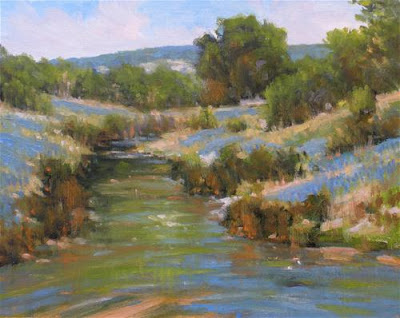
On the River
(click here to see original image)

Secondly, seeing my progress so far is exciting to me. I know I have far to go and I have lofty expectations for myself, but feel confident that good things will happen for me if I remain patient and persistent.

Thanks, David!

© 2012 Jennifer Newcomb Marine

Thursday, August 23, 2012

DPW Spotlight Interview: Sarah Sedwick

Each week we will spotlight a different DPW artist who will give away one of their best paintings. 

To enter to win Sarah Sedwick's painting, "Apple Bowl with Apple Blossoms," go to Daily Paintworks and click on the Spotlight Giveaway button in the top-left corner of the website.

From Sarah's DPW Gallery page:
My real passion is putting brush to pigment, paint to canvas. I got my BFA at MICA (in Baltimore) and now live in Eugene, Oregon. My recent work has been mainly still lives and nudes, all painted direct from life, no photos.
Tell us a bit about how you first started painting.

I’ve been into art as long as I can remember. I was ten years old the first time I tried oil paint. I’m not saying it was love at first sight – it seemed like kind of a stinky complicated mess back then. Also, I almost got trampled by my first live model - a horse!

Apple Bowl with Apple Blossoms
(click here to see original image)

Enter to win by clicking the "Artist Spotlight and Giveaway" button!

Did you have any stops and starts in your painting career?

After I graduated from art school, I went through a period of intense self-doubt during which I did almost NO art for about seven years. I can't believe it, but it's true. What did I do with myself during all that time? I waitressed, worked in a bookstore, watered plants in office buildings (yes, that’s a real job), fell in love and got married.

We settled here in Oregon five years ago, and I just knew it was time to begin painting again. Now I can’t imagine going through another dry spell of that length, though it did take me six months to get back in the studio after my daughter was born in ‘09.

Peppers and Wedges
(click here to see original image)

What mediums and genres have you experimented with? Which ones have "stuck" and which ones have fallen away? Which ones are you looking forward to exploring?

Throughout childhood I was a serious felt-tip pen fanatic. I filled countless drawing pads with black and white drawings (of princesses). Later I went through a long phase with pen and ink and gouache. I used all kinds of different colored pens, pencils, sticks - whatever was around - in my sketchbooks during college. Sketchbooking is the one artistic practice that I really want to get back into. Lately all my art time is focused on painting, but one day I will be toting that black-covered sketchbook everywhere with me again.

Your work is an intriguing mixture of very fine, but vibrant still lifes and direct, but relaxed nudes. What can you tell us about what you are drawn to capturing in paint?

Thanks for saying so! I do feel that they are different bodies of work, but painting figures refuels my passion for still life when I get into ruts. I’m always surprised by how much of my still life practice is applicable to painting the nudes. I don’t experience much difference between painting a bowl of apples and, ahem, round parts of the female anatomy – aside from mixing flesh tones, which is pure fun.

Kai
(click here to see original image)

In still life I’m usually trying to capture a certain quality of light, or a color combination that is really inspiring me that day. I also love working with shadows as part of a composition.  When I paint the figure, I try for drama – dark darks, lost edges - and I always get a thrill from capturing a facial likeness.

What does procrastination look like for you? What techniques work to ensure that you make time for your art?

Procrastination for me, at its worst, can be summed up in one word: the internet! I have some healthier forms of procrastination, though: maintaining my Etsy shop, research (aka stalking other artists’ blogs), and running. At least when I’m running I can theoretically be brainstorming painting ideas, though I’m usually just jamming to music and checking out what the other runners are wearing.

How do you generally arrive at ideas for your paintings?

Most of my paintings aren’t narrative, and they I don’t usually intend them to represent grander themes. (You won’t find an ‘Assumption of the Virgin’ on my website.) If the persimmons are ready to be picked over at my mom’s, I’m excited about painting persimmons. And I know I’m not the only DPW artist to seek inspiration in the produce department!

Irises on a Low Table
(click here to see original image)

Often, I’ll add elements to a still life based on color combinations I want to try. I’ll never stop being fascinated by what color can do to manipulate the whole mood of a piece.

How do you keep art "fresh?" What techniques have helped you avoid burnout and keep your work vibrant and engaging?

When I feel burned out, I go to the thrift store! Honestly, a day spent browsing for new things to paint sends me back to the studio excited. New fabrics and colored-paper backgrounds are also great that way.

What do you feel you are learning about right now as an artist?

I’m learning about teaching, for one, which is a universe of newness for me! I’ve taught some small workshops, and learned a ton about myself as an artist doing it. (Maybe I should have been paying them!)

I’m also constantly learning new things about blogging, marketing, creating my “brand” and reaching out to my colleagues and collectors on the internet – and locally! I’m an artist, and I love to hide out in my studio - but putting myself ‘out there’ has been really rewarding.

The Red Rasta
(click here to see original image)

What makes you happiest about your art?

There’s nothing like finding that ‘zone’ of perfect concentration. When I’m there, I seriously feel like a rockstar. Of course, that high may not last through my first look at a painting after a night’s sleep, but in the moment of creation, it’s pretty sublime.

I also really love hearing feedback from my customers. A woman recently wrote to tell me that her children had made up their own names for all my paintings, and that was priceless! Feeling connected to a community of art-lovers is so great.

Thanks, Sarah!

© 2012 Jennifer Newcomb Marine

Thursday, August 16, 2012

DPW Spotlight Interview: Karen Margulis

Each week we will spotlight a different DPW artist who will give away one of their best paintings. 

To enter to win Karen Margulis' painting, "Maine Landscape with Lupines," go to Daily Paintworks and click on the Spotlight Giveaway button in the top-left corner of the website.

From Karen Margulis' DPW gallery page:
I've been creating a daily painting since 2005. My work is represented by fine art galleries in the Georgia, North Carolina and Oregon. I'm a Signature Member of the Pastel Society of America and a Member of Excellence in the Southeastern Pastel Society.
Tell us a bit about how you first started painting.

I took art classes in high school, but didn't start painting until my own children were in high school and I found myself with extra time. I started doing a small daily painting and posted it to my blog so that I could improve my painting skills. I have been doing a daily painting for 7 years now!

Did you have any stops and starts in your painting career?

Once I started painting, I haven't stopped. I recently retired from my day job to paint and teach full time. I can't imagine ever stopping now that I've rediscovered art.

Maine Landscape with Lupines
(click here to see original image)

Enter to win by clicking the "Artist Spotlight and Giveaway" button!

What mediums and genres have you experimented with? Which ones have "stuck" and which ones have fallen away? Which ones are you looking forward to exploring?

I started with watercolor, but quickly discovered that pastel was my passion. I love the vibrancy and the immediacy of pastels. I have recently started exploring oils and I really do enjoy the texture I can get with paint. I look forward to working to improve my skills with the brush....

Wildflower Pastel
(click here to see original image)

There's such an ethereal, dreamy quality to some of your work, especially your landscapes. Is that a quality you already see when you settle upon a composition, or do you pick a setting and then attempt to gently "steer" a painting in that direction?

Great question! I am drawn to the ethereal quality in the landscapes, so often I do see these things before I start painting. But a lot of the dream-like quality of my work comes from the underpainting techniques I use. I often begin a painting with a loose and drippy underpainting. By starting out with soft edges, I am able to retain the soft quality and only sharpen edges in my focal areas.

What does procrastination look like for you? What techniques work to ensure that you make time for your art?

I am fairly good about getting things done without too much procrastination. Having the daily blog and being a part of Daily Paintworks helps me stay focused on painting. I usually take care of business in the morning and paint after lunch. Keeping a routine makes it easier for me.

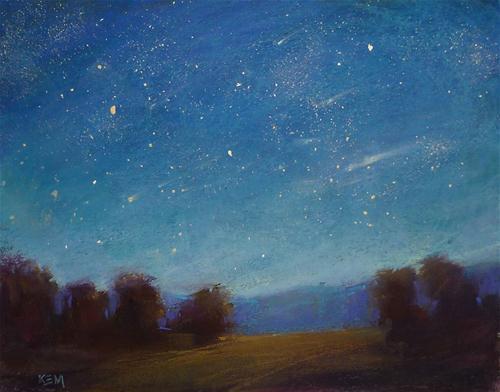
Meteor Shower
(click here to see original image)

How do you generally arrive at ideas for your paintings?

I have thousands of reference photos that I have taken and when I need a painting idea, I will skim through them until something jumps out at me. Often one painting will inspire ideas for more paintings and a series is born! Other times my paintings are done to illustrate a topic for one of my classes or workshops. I learn much from painting these 'demos'!

How do you keep art "fresh?" What techniques have helped you avoid burnout and keep your work vibrant and engaging?

I like to give myself small painting challenges to keep things interesting. I also give myself permission to experiment with different techniques and mediums. By trying new approaches and new subjects, I keep things fun for me and I also often discover ways to make my usual work even better.

Siamese Cat
(click here to see original image)

What do you feel you are learning about right now as an artist?

Since I am exploring the world of oil painting right now, I would say I am learning a lot about color and how to mix the colors I need. With pastels we just have to have the right color stick. I had always heard how learning another medium helps you with your primary medium and I can see now how that is true. This is an exciting time for me!

What makes you happiest about your art?

Easy. I love that I can make someone else happy with my work.

A Sunny Day
(click here to see original image)

One of the great things about Daily Paintworks is that I know who my collectors are and I get to hear their stories. It is so satisfying to have a dialog with my collectors and know that my work has moved them and why. I love sharing both my work as well as teaching; sharing my artwork and my art knowledge is so gratifying...

Thanks, Karen!

© 2012 Jennifer Newcomb Marine

Thursday, August 9, 2012

DPW Spotlight Interview: Brian Cameron

Each week we will spotlight a different DPW artist who will give away one of their best paintings. 

To enter to win Brian Cameron's painting, "Surfin' Safari," go to DailyPaintworks and click on the Spotlight Giveaway button in the top-left corner of the website.

From Brian's DPW gallery page:
Brian has been painting full time and showing professionally since 1998. His work has been featured in the magazines Coastal Living and Open Spaces and on Portland's PDXPOSED television program. He  illustrated "Encounters With Small Creatures By The Sea" by Phyllis Knutson, PHD and wrote and illustrated a children's book, "What Woofie Wants."
Tell us a bit about how you first started painting.

Hmm... can't remember. Wait -- it's coming back.

I was sidetracked for a long time. After heading to college with a small art scholarship in hand, I dropped out to see what life outside of school was like. I worked different jobs and played around and met a few girls and woke up one day married with children!

Surfin' Safari
(click here to see original image)

Enter to win by clicking the "Artist Spotlight and Giveaway" button!

I spent many years in the building trade, eventually opening a cabinet shop. The cabinet making evolved into furniture making. I began to get the furniture in galleries and it sold well. Once I was established in a few galleries, I decided I was an artist, so the furniture making evolved into sculpture. The sculptures evolved into wall hung assemblages. Some of the assemblages were painted and so, in time, I began just painting on large flat Masonite panels. Mostly abstract fields of color. Just colors and shapes arranged in what I felt were pleasing, well balanced compositions.

I was fascinated with minimalist art. Bold and colorful compositions that were compelling and beautiful had been done by some of the masters and I just wanted to do what they did.

Did you have any stops and starts in your painting career?

Once I started painting, I pretty much let the sculpture and woodworking go. I liked the idea of just paint and canvas. The other genres involved so much more time and materials. Painting doesn't require as much prep, so I found it liberating to just jump in and paint.

The Derby
(click here to see original image)

But there have certainly been setbacks. 9-11 was probably the worst. The gallery business faltered immediately and hard as it was to make a living in art before that... it was even worse right after. Eventually, I grudgingly took a job as a carpenter to catch up on the bills and felt like maybe I was done for as an artist. But then after a couple years, I just couldn't take it anymore and had to jump back into the creative life again full time. I remember being so glad to get back to the studio and crank out work.

Aside from the self inflicted 'dry spells' that come from self doubt, I managed to keep painting pretty regularly and then the financial collapse in 2008 dried up the gallery business again. But I've pressed on with the painting though.

What mediums and genres have you experimented with? Which ones have "stuck" and which ones have fallen away? Which ones are you looking forward to exploring?

Like I said before, I've sculpted in wood and even concrete and a little metal. Actually, I still love working in wood. There's something about a sharp blade cutting through wood that turns me on. And I've done a fair amount of printing from woodcuts which I enjoy too.

Bold Crow
(click here to see original image)

I did the usual dabbling in watercolors but didn't care for it much. I'm pretty stuck on oils and acrylics. I spend most of my time working in acrylics simply because it's cheaper, dries faster and is cleaner to work with. But I do work in oil too. Oils have a truer color in that how they appear when they hit the canvas is close to how they'll look when dry. I like that about oil.

Acrylics, on the other hand, 'dull out' after initially appearing rich in color. So as the painting progresses, you have to keep retouching some areas because of the loss of intensity. I remember when I first started using acrylics, I would come to the studio in the morning after spending all day on a piece and wonder what had happened. The painting often looked considerably different than when I left the night before. At first I thought it was just my imagination or that my vision for the piece had changed. As I worked with it more, it became clear that it changes in intensity all day, so you have to compensate for that. Oils do the same thing, but not nearly so dramatically. I'm sure all oil painters have to go back and retouch some spots, especially the bright lights.

As far as genres go, I am one of the world's worst at sticking to any style or genre. I love abstract as well as representational work. I can easily get bogged down with detail and move a painting into realism, but I prefer to stay very loose and even a little abstract if I feel like I can get away with it. I know most of the clientele in the daily painting arena expect to see representational pieces so for this venue I try to keep it small and recognizable. Then too, I don't feel abstract works very well on such a small scale.

I look forward to exploring nudes. Of course, not while my wife is alive.

You cover quite a range in your subjects, from the stately and majestic, to the more ordinary stuff of daily life. What stops you in your tracks and makes you think, "I've just got to paint this!"?

Well, actually that's just how it goes sometimes. I literally stop in my tracks and think "I've got to paint this." The good news is... when that happens, painting is a gift from above. So I don't know what it is that stops me in my tracks. Call it the muse or inspiration or a heavenly messenger or whatever. When it happens, it's time to drop everything and paint.

The Flutist
(click here to see original image)

I used to think that feeling would wait and hang around until I was ready to go to work but  it doesn't. I read an interview with Neil Young once that touched on that. I can't quote it, but Neil mentioned that at one time, he took it for granted that the muse would always be at his command, but later realized that when the inspiration comes, you just have to drop everything and go with it.

Some days, though, are just a matter of going to the studio and putting paint on canvas searching for something in the painting that pulls you in some direction. I'm always looking for a subject that is either quirky and fun or so beautiful that it shouts, "Are you blind? You have to paint me!"

So yeah, I have painted things as ordinary as an oil can and screwdriver some days and that's fun and good practice. But other days I look a little higher. There is a lot of wonder in this world. To catch a tiny bit of it on canvas is magic.

What does procrastination look like for you? What techniques work to ensure that you make time for your art?

You know, I don't think I procrastinate too much when it comes to painting. I procrastinate about other things, but the only thing that really keeps me from painting is the foul mood I get in when things aren't  selling. It is hard to keep painting when it just piles up in the studio or in the storage room of some gallery.

Chickadee Delight
(click here to see original image)

I suppose if I were just doing it for leisure activity, it wouldn't bother me so much. But when you are trying to earn your living from it, the demons sneak in and steal away your joy with little comments like, "Are you nuts!" or "You can't make a living painting pictures!" or "Real men hold down real jobs." But having had a long acquaintance with them, I have pretty much identified those voices as puny little spirits attempting to derail me on my rightful journey.

I think I would say you have to look at it as your job as best you can. You have to go to the studio and put in the time, either slapping paint on canvas or at least stretching canvases or something art related. Some days are for painting... some days are for the peripheral stuff associated with painting, but I need to keep at it all like a job.

I'll tell you one thing: if I take some time away from the studio and go do some serious labor like cutting trees or digging a ditch or re-roofing the house, when I go back to the studio that place looks like heaven. So I try to keep that in mind.

How do you generally arrive at ideas for your paintings?

The abstracts are, of course, pure imagination. Sometimes I see a group of shapes and colors that would make an interesting idea for an abstract painting, but mostly I just think of things I'd like to see hanging on my walls.

Since I started doing the little daily paintings, the need for new subjects or ideas has become a bit of a challenge. But then part of the daily painting thing is just to be painting everyday, so subject becomes less important. Not all dailies are intended to be masterpieces. Many are pure pleasure and practice. So painting an oil can on a block of wood is ok for that. Or a telephone. Or a can of old paintbrushes.

Key to What


I do, though, try to think of what the market might want too. I wonder sometimes, if I were a wealthy patron of the arts, what would I want to buy?' Now, you all have to admit that is part of what we do as painters. Shameful isn't it?!

How do you keep art "fresh?" What techniques have helped you avoid burnout and keep your work vibrant and engaging?

I hope people do find my work 'vibrant and engaging! ' Oddly enough, starting the daily painting regime has helped me a lot in that regard. I used to paint only large format pieces and thought the idea of painting small 6x6" pieces was absurd!

Once I began doing the little ones, I found it nice to switch back and forth from large pieces to small ones. Usually, I do a series of little ones and then launch in to something large. The change is refreshing -- to go from wearing reading glasses and sitting -- to standing up and taking broad strokes with a 6" wide putty knife. The large works lend themselves to large tools and brushes and lots of walking around.

What do you feel you are learning about right now as an artist?

I am always learning. This 'self taught' artist thing is all about learning the hard way. I never had enough sense to actually take classes, so I have to figure out everything by myself. Trial and error seems to be the only way I can learn. Seriously, I think I am making small strides in the direction of what some call signature work.

For years I've wandered all over the spectrum of technique and style. And for a long time I thought that was good. I didn't want to be pigeonholed. But I think I'd like to settle down a little and try to make my work recognizable as being from me. I'm learning slowly that there is a style that I prefer. I think I'm just about there or just about to figure out where 'there' is.

What makes you happiest about your art?

A lot of things make me happy. When I start a painting and it just falls off my brush so quick and easy that I'm amazed. That is one. Or when I get stuck on a big piece and can't seem to find my way to the end and suddenly lay down one stroke that either finishes it completely or at least puts it over the top... That's another.

Bite Size
(click here to see original image)

When someone buys a big expensive one that pays the mortgage, that feels pretty good too. And when someone sincerely loves one of my pieces and I feel I made something that touched someone... hard to beat that feeling.

I guess mostly to think that maybe it really is a gift from God that might be doing something good in this world -- and I get to be part of it.

Thanks, Brian!

© 2012 Jennifer Newcomb Marine

Thursday, August 2, 2012

DPW Spotlight Interview: Elizabeth Floyd

Each week we will spotlight a different DPW artist who will give away one of their best paintings. 

To enter to win Elizabeth Floyd's painting, "Pink Hyacinths," go to DailyPaintworks.com and click on the Spotlight Giveaway button in the top-left corner of the website.

From Elizabeth Floyd's DPW gallery page:
I am a full time artist. I paint in a realistic manner, using vivid colors and thoughtful compositions which reflect my appreciation of beauty in all things I encounter on a daily basis. In March 2009, I completed a career transition to art after more than a decade studying and working in the architectural field.
Tell us a bit about how you first started painting.

The first time I painted with oils was in 2006 and I immediately fell in love with the rich juicy colors you are able to achieve with this medium. Prior to working with oils, I mainly drew with graphite or ink and used watercolors to add a bit of color to the drawings.

Pink Hyacinths
(click here to see original image)

Enter to win by clicking the "Artist Spotlight and Giveaway" button!


Did you have any stops and starts in your painting career?

Wanting to be an artist was a secret dream of mine for many, many years. So in a way I had a long period where I did not acknowledge my artistic side and repressed it. I never expressed the dream of being an artist to anyone until my thirtieth birthday, when I shared it with my husband. He was especially encouraging and gave me the confidence to begin working towards my dream. For the first two years I focused on drawing and watercolor, then I tried my hand at oils and never looked back.

What mediums and genres have you experimented with? Which ones have "stuck" and which ones have fallen away? Which ones are you looking forward to exploring?

I have pursued still-life, landscape, and the figurative (portrait and anatomical) genres, coming to realize I personally respond most when working with still-life and landscape scenes. Of mediums, I have worked with watercolor, graphite, charcoal, pen and ink, pastels, oils, and sculpture.

Each medium has had its place in helping me grow as an artist, however the medium I have most enjoyed exploring is working with oil paint. The vast diversity of effect and application methods that can be employed when working with oils has captivated my attention for the most part. I am drawn to how, with a subtle change in thickness and transparency of paint, I can affect the emotive expression; shifting and adopting to all the nuances of personal expression that can be so hard for me to articulate verbally, but flow when I try to express them visually through a painting.

Still Life with Persimmons on Pewter Plate(click here to see original image)

Two mediums I am looking forward to someday exploring are encaustic and etching. I am drawn to encaustic because I love the thick, layered and translucent quality of the medium, along with the ability to embed found objects into the layers and surface. While with etching, I love the quality of line and mark-making that is possible, especially with the drypoint technique. However, I anticipate it will be a long while before I dive into these interests. I still feel there is so much to learn and apply when working with oils.

There are these lovely, brooding darks in your work, balanced out by beautiful, delicate brights. What can you tell us about your greatest influences and how you developed your style? 

When I first started studying fine art, I did a lot of reading and I came across this quote by Robert Henri:
“Don't worry about your originality. You couldn't get rid of it even if you wanted to. It will stick with you and show up for better or worse in spite of all you or anyone else can do.”
This quote stuck with me when I first started painting with oils, so I never worried about developing a specific style, instead I focused on improving my technique, because I believed if I knew how to handle the paint I would be better equipped to create and share what I was trying to express.

In addition to reading a lot and trying to heed all I was learning, the greatest influence was also the lucky chance of being able to take many classes and workshops taught by the talented portrait and still-life artist, Danni Dawson. Getting to study with her has made the most pivotal impressions on my art career. I could go on for hours about how she has helped me be a better artist and improved my ability to critically observe and then translate these observations into paintings… I owe her so much for how very generous she has been to me.

Stargazer Lily
(click here to see original image)

What does procrastination look like for you? What techniques work to ensure that you make time for your art?

Right now my life is very full with the responsibilities of having a 12-month old daughter. She goes to a sitter during the work week and if I do not paint during those hours, I will not get to paint. So procrastination does not have a place in my life right now and when asked about when I make time for “me,” I answer that time when I get to paint is the best “me” time I could ever have.

And as for ensuring I make time to paint, the only technique I employ is that I always try to have one or two compositions going or in my thoughts, so when I am free to paint, I have already completed a lot of the problem solving issues that go into starting a painting before I ever walk up to the easel. For me, if I do not know what I am going to do the next time I get to paint, I will waste valuable time trying to figure it out.

How do you generally arrive at ideas for your paintings?

I keep an “idea journal” where I jot down ideas, words, and thumbnail sketches about paintings or a series I would like to further develop. Over time, a bunch of ideas are jotted down and often when I go back and look at the ideas I begin to see similarities and common themes that adapt well into developing a series.

How do you keep art "fresh?" 

I always try to paint from life using natural light. My studio windows face northeast, and from day to day, and season to season the quality of light varies. This always keeps me on my toes, as I must adapt to the weather conditions because the quality of color is vastly different on a bright sunny day versus a gray overcast day. Also, when painting flowers I have to keep up a good pace because flowers change over time, sometimes a lot over a course of a few hours. One time when working on a painting with tulips, the tulip stems grew almost ½” in the course of four hours, making the flowers significantly higher from the edge of the vase than when I started the painting. Mentally, I was constantly adjusting for this difference while painting.

I believe working from life and coping with the potential of change gets captured, and a wonderful “dither” occurs that brings life to a subject. Harold Speed in The Practice and Science of Drawing defines the word “dither” as that elusive quality, that play on mechanical accuracy, existing in all vital art.

Garden Harvest
(click here to see original image)

What techniques have helped you avoid burnout and keep your work vibrant and engaging?

To avoid burnout I try to always choose a set up that is mentally challenging, this keeps me engaged. If this does not work, I will then shift to a different genre or medium for a day or two, and by working on something different, I get revitalized to go back and re-attempt what was not working out before.

What do you feel you are learning about right now as an artist?

In 2012, I set a challenge to work on a series where I complete an 8x8 inch painting every week inspired by the passage of time and the seasons. Each piece is a reminder to celebrate the beauty found in our daily lives, so each new scene is composed of items found around my house or garden, or gathered from a neighbor or farmer’s market.

Dandelions
(click here to see original image)

The most important thing I have learned by working on this series is that for a painting to be a success it must have a supporting idea, something central, a focus that organizes how everything is treated within the composition. I have learned that when a painting is not working out, it is because I have lost the focus of the idea. Many paintings have been scraped down or put aside due to losing the idea. I am also learning that it is always better to regroup and start over then try to force and power through, because the painting will somehow be shallow, even if it is technically correct.

What makes you happiest about your art?

When what drew me in also speaks to the viewer. Overall, I want to share my sense of beauty with others and there is nothing more rewarding than knowing that someone else has connected to a painting I have created.

Thanks, Elizabeth!

© 2012 Jennifer Newcomb Marine

Thursday, July 19, 2012

DPW Spotlight Interview: Mariko Irie

Each week we will spotlight a different DPW artist who will give away one of their best paintings. 

To enter to win Mariko Irie's painting, Sunny Sunset Cliff, go to DailyPaintworks.com and click on the Spotlight Giveaway button in the top-left corner of the website.

From Mariko Irie's DPW gallery page:
Mariko Irie, a lifelong painter, was born and raised in Tokyo and currently resides in Santa Rosa, California. She has been in numerous solo and group shows and her work is collected privately and publicly throughout the U.S., Japan, England, Germany and Canada, including the Miasa Governor in Japan. She has been exhibiting in galleries for the past 22 years.
Tell us a bit about how you first started painting.

My mother watched me enjoying painting when I was in preschool and took me to a painting class when I was an elementary school. Up through high school, my media was oil pastel, which is very common for children - so was crayon, but I didn’t like it. I won prizes for my paintings.

When I was a high school, I got an oil paint set. I used to go out and paint by the river. I loved painting and drawing all the time, but I was not thinking I'd ever be a painter or an artist. One of the reasons why: my art teacher in high school was great - but the substitute who had just graduated from an art university came to teach us. She believed that only abstract painting was Art. She criticized my paintings so badly, I quit painting in class.

Sunny Sunset Cliff
(click here to see original image)

Enter to win by clicking the "Artist Spotlight and Giveaway" button!


Then I was became fascinated by the idea of becoming a designer. So I went to art school to prepare for the entrance examination for Art University and studied drawing and composition. I passed the examination for Musashino Art University in Japan and my major was Interior Design.

After graduating, I became an interior designer. The economy was a bubble at the time, so I was making great money. But after ten years, I felt something lacking in my life; there was a hole in my body. I quit my job and married, but that was not answer either.

It took me long time to figure it out. After I settled in Mendocino, I started painting again. Right before I turned forty years old, I asked myself: If I knew that I would die tomorrow, what would I want to do? 

The answer was painting.

Did you have any stops and starts in your painting career?

Galleries started to show my work in 1989 and since then, I have never stopped painting. I have two sons; the younger son was two years old in 1989, when I moved out from my ex-husband’s. First, I was taking classes at the college and the classrooms were my studios. When my sons started to go to school, our living room was my studio.

What is the next?
(click here to see original image)

Five years later, we moved into a bigger house and I got my own studio space. I worked on my art when they were at school and until they got driver licenses, I was their driver. I was happy to do so, because I wanted to enjoy them. It was precious time in my life and I knew it wouldn’t last forever. Now they have both graduated from universities and have their own lives.

What mediums and genres have you experimented with? Which ones have "stuck" and which ones have fallen away? Which ones are you looking forward to exploring?

In 1989, I took a printmaking class at the College of the Redwoods. I did etching, monotype and serigraph. During my first exhibition at the college, my etchings sold. So I took them to show at a gallery and they started to sell them. I felt so lucky.

In the late 70’s in Tokyo, I saw “American Super Realism” paintings. It was sensational. I was fascinated by these paintings. They were such a simple concept; the painters were painting exactly what they were seeing and they were somehow even more realistic than photography.

Sunset Time
(click here to see original image)

Then I took painting class with Bill Martin. He was a master Surrealism painter and an instructor of painting at the College of the Redwoods. I wanted to learn Super Realism technique from him. He passed away in 2009, but his family continues his website: http://www.billmartingallery.com/

At one point, I became allergic to oil paintings and all solvents, so I switched to watercolor. I've painted watercolor for over twenty years now. It’s an incredible media. If we try to control it, we end up losing control. But if we let watercolor paint itself, it creates a fascinating painting.

Three years ago, I moved to San Diego. The climate there is much dryer than Mendocino. My watercolor technique wouldn’t work well, because it would dry too fast. I joined the plein air groups and took water-mixable oils. I learned from other artists how to paint fast. It was a big challenge for me, but it was great, even with the struggling.

I’m having fun with water-mixable oils now.

Many of your paintings are set outside - at the beach, during sunrise or sunset. There's such a lovely quality of light in your art, as if we're actually seeing real sunlight. What can you tell us about you make your work look so true to life?

Thank you for saying that, it's a big compliment. Sunset, sunrise. The beautiful moment is so short. I can’t paint fast enough at the location itself - especially an 11” x 30” watercolor painting, which takes about a week to finish.

So I take photos. I spend time staring at the scene, trying to absorb the light, shadow and colors. Then I paint at my studio. When I start to paint, I don’t think of any one thing, I'm just in my painting world - and then - the painting is finished. From my experience, when paintings are done this way, they make the best ones.

Shoes
(click here to see original image)

What does procrastination look like for you? What techniques work to ensure that you make time for your art?

Procrastination: I can’t do it! It’s my nature. If I know that something should be done, I have to do it right away. Otherwise, it just sticks in my mind and I can’t do anything else. But sometimes, there are too many things to be done, so I just make a schedule and a check list.

What techniques work to ensure that you make time for your art?

Having a solo show at a gallery. That makes a good excuse for focusing on painting.

How do you generally arrive at ideas for your paintings?

A lot of times, I work from photos. When I’m staring at an image, I start to remember that moment. During other kinds of my paintings, for example, “Opening of Happiness,” I just think, “What is happiness?” and the image comes from that. Sometimes a gallery will have a group show with a theme. For instance, the last theme show I did was “Love Note” and I painted “Encounter” and “Art Lovers” for that.

How do you keep art "fresh?" What techniques have helped you avoid burnout and keep your work vibrant and engaging?

When I’m exhausted, whatever I see looks horrible, so I take a nap. That helps a lot. Or I might change the subject for my paintings or play on the surface of painting to create a new technique. It’s a part of learning the media all the time, a process that always stimulates me. Taking trips helps me a lot too. It takes my mind out from studio, then I come back renewed, with a vision.

What do you feel you are learning about right now as an artist?

I’m so lucky to be an artist, because I'll be learning forever. It refreshes my life all the time and now we have all this information through the internet. Art is forever and alive.


Daffodils Glow
(click here to see original image)

What makes you happiest about your art?

When my paintings come out better than I imagined. When people smile in front of my paintings, I’m very happy; it's like my paintings have brought joy to this world. When somebody falls in love with my painting and brings it into their home, that makes me so happy. I feel that I connected with them through my painting.

Thanks, Mariko!

© Jennifer Newcomb Marine

Thursday, July 12, 2012

DPW Spotlight Interview: Nancy Parsons

Each week we will spotlight a different DPW artist who will give away one of their best paintings.

To enter to win Nancy Parson's painting, River Walk - San Antonio, go to DailyPaintworks.com and click on the Spotlight Giveaway button in the top-left corner of the website.

From Nancy Parson's DPW gallery page:
I began a blog in the summer of 2010, as my husband Dave and I embarked on a 4,000 mile, six-week, artist sabbatical in our little pop-up camper. I began painting and posting each day on my blog at www.headondownthehighway.blogspot.com. Since returning, I have continued to paint and post as a daily painter of what I have coined Not-So-Still Lives. 
Tell us a bit about how you first started painting.

I began painting in kindergarten. As one of nine children, my art was the only way I could get noticed. Luckily my parents affirmed me with art lessons or there's no telling what I'd have done with my life.

I remember consciously deciding to be an artist at age six. By the time I graduated from high school, the thought of being a female painter in 1966 sounded way too scary. Out of fear of dying on the sidewalk from starvation, I studied commercial art in college.

Although I have always painted to some degree, taken scattered painting classes, and even won an award here and there; I really didn't start painting on a regular basis until a little over two years ago when my husband and I took off for 6-weeks in our pop-up camper. I began painting everyday and blogging. When we returned home, I was invited to do a one-woman show at a local gallery and sold enough work to pay for our entire trip. I was hooked and immediately signed up for a couple of workshops with two of my favorite artists (Carol Marine and Rene Wiley), joined several art organizations, bought and devoured every used art book I could get my hands on, and really began studying art.

River Walk - San Antonio

(click here to see original image)

Enter to win by clicking the "Artist Spotlight and Giveaway" button!

Did you have any stops and starts in your painting career?

Lots of them. When my kids were little I was painting in watercolors and participating in local art shows, painting wall murals, and doing commissions for neighbors. Life was going good, or so I thought, until my first husband suddenly walked out the door and my world and fine art dreams collapsed.

Out of desperation, I took a full time job in international banking, but after 5 years was bored out of my mind. I eventually went back to art school and graduated from the Art Institute of Houston in Advertising Design, and then started my own graphic design business in 1984. I was still painting here and there and taking a few workshops, but dying with desire to paint full time.

So, after another 26 years of raising a family and running my design business, I realized that time was ticking away and if I didn't figure out a way to make this happen, I would never get to be a painter. I made a commitment then and there to start painting nights and weekends. I made that decision over two years ago and can honestly say I am happier and more excited than I've ever been in my life!

Z-Zinnia Tops
(click here to see original image)


What mediums and genres have you experimented with? Which ones have "stuck" and which ones have fallen away? Which ones are you looking forward to exploring?

In the past, I have worked in many different genres and mediums including: watercolor, prisma color, scratchboard, gouache, airbrush, acrylics, pen and ink, charcoal, clay and silkscreen. For some reason, those mediums were not loud enough or loose enough to satisfy me. I longed for my work to be bolder and scream with intense color.

I now work exclusively in oils and love the flexibility and rich creamy texture of the medium. I currently work with pretty thin paint, but hope to learn to use thicker applications as I grow in my art. I usually only work with primary colors, plus white and umber, but lately have begun to explore other palettes and colors. This has made me feel like a kid in a candy store!

There's a wonderful relaxed, peaceful quality to many of your paintings. What can you tell us about how your compositions reflect your personal approach to life?

I think my compositions and subjects are intimate, honest and—hopefully—full of life and joy. I have a very active imagination; painting gives my inner child permission to come out and play. I like to paint in total quiet, so I can listen and hear. Painting is a meditation for me into the silence… like a prayer.

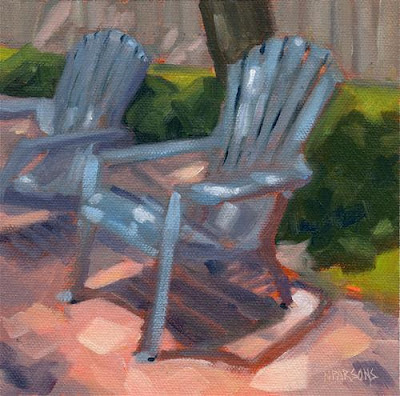
Shady Characters
(click here to see original image)

Once a painting feels complete, I become aware of something more wanting to be revealed. That's when I love to blog and share what my paintings have to say. I've never considered myself a writer, however I now feel my writing has as much to say at times as my paintings do. This has been an enormous step out of my fear and self-imposed limitations.

What does procrastination look like for you? What techniques work to ensure that you make time for your art?

Procrastination—if it comes looking for me—looks like fatigue or exhaustion. I know I push myself pretty hard and only get about 5-6 hours of sleep a night. I am a big believer in balance of body, mind and spirit. This is the secret I've learned which makes everything else I do work. Priorities come first.

I'm up early most mornings and in the pool by 5:00, followed by daily Mass, and then coffee with friends. By 9:00 a.m. or so, I'm ready to begin a full day of graphic design, followed by dinner with my husband and then—my playtime—painting and blogging.

How do you generally arrive at ideas for your paintings?

I carry my camera or phone everywhere I go and am always on the lookout for color, light, reflections and shadows to jump out at me. Road trips are a gold mine and I drive my husband crazy with my incessant screams to "Stop the car... let me out!" I find paintings everywhere, even out walking my dog.

If I ever run out of ideas, I take a trip to the produce and flower aisles in the supermarket. You wouldn't believe how many colorful characters jump up and down, begging to get into my cart.

How do you keep art "fresh"? What techniques have helped you avoid burnout and keep your work vibrant and engaging?

Bold strokes of clean color are the bomb!!!!  I try with all my might to put a stroke of paint down once and then leave it alone. Mud is the enemy to be feared and avoided at all cost.

Bend
(click here to see original image)

The key to avoiding burnout for me is always looking for something fresh and alive that excites and challenges me to paint, before I show up at the easel. I try to work loose and let parts of my tinted red canvases peek through here and there. I think these are major keys to help keep my paintings alive. If I start to get tight and fussy, I'll wipe the whole painting off and start over. There really are no mistakes in painting, just discoveries. Walking away from a painting—even before I think it’s finished—is my goal.

What do you feel you are learning about right now as an artist?

I am learning how to see, hear and feel on a deeper level... letting go and giving myself over in trust. I believe artists are all little brushes in the hand of the master Creator himself. He uses us as His instruments to express and share His love in the world. It's not always easy being a brush… but what the heck… someone has to do it. :-)

Rainy-Day Sunshine
(click here to see original image)

What makes you happiest about your art?

I am happiest with my art when I am feeling the most vulnerable—and yet to my utter surprise—finding that vulnerability somehow opens portals that communicate and resonate with others.

Anaïs Nin, a French-Cuban author once said, "Life shrinks or expands in proportion to one's courage."  I believe painting demands tremendous courage just to show up, but rewards courage with tremendous joy, satisfaction, and an intense appreciation and humble gratitude for the precious gift we call life.

Thanks, Nancy!

© Jennifer Newcomb Marine